Change the Method Not Goal


With so many things we would never tackle them on our own, for example plumbing or electrics yet so many other things despite having zero expertise we do a bit of reading and swiftly declare ourselves an expert and capable of doing it ourselves with zero expert advice.

I’ve definitely seen this with people and exercise,  more frustrating those that struggle with injuries. I usually hear “I tried …….and it didn’t work/made it worse” They may then try the same thing again, maybe something else or eventually give up and declare the problem unsolvable. 

( I’m not even going to go into my frustration with those that do 1 maybe 2 sessions with an expert and because the results are not instantaneous or requires them to do homework that they don’t actually do they also declare that as not working……) 

The thing is the human body is a complex bit of kit. Whilst in theory we are built the same our bodies have not had the same experiences or history, they do not lead the same lives or move in the same patterns. They are also not powered by the same brain. 

This means making it move and perform better is not a one size fits all approach. If you’re struggling an expert can help you see why, they can tweak exercises to make them fit you better and tell you when you may not even be doing them correctly at all. 

They can give you the confidence to keep going when you panic that the injury has come back or your pain is still there. Having someone to say it’s ok I’ve seen this lots of times it’s completely normal, just keep trying; can be the difference between pushing through to the next level and giving up. 

An expert will have spent time and money learning about human movement, they will have seen lots of different people with lots of different problems all coming from a different head space and been able to use those hard learnt skills to help them. 

You don’t declare yourself a Plumbing expert after 1 YouTube video so if you’re struggling with your body treat it like your plumbing and get an expert in to help you. 

You have a trainer to help you and your horse work better together so why not have one to make you and your body work better together.

Totally unrelated I’ve got space for 121 in person training if you’re local to my studio - WN8, and I’ve got space for Zoom training if you’re not 😉.
 

Dedicated to Better

I started reading Charlotte Dujardins autobiography last weekend. I think whilst it’s clear that she has a natural gift and as she says herself in the book instances where she just happened to be in the right place at the right time (I’m a believer in fate) there is something else that she talks about that I think we can all learn from, and that is her constant desire to assess her own performance and continue to learn and grow as a rider.

She talks about watching Carl’s dvds over and over when she was young, watching other people’s tests and trying to pick up training tools and ways to be better. 

She would watch back her own tests, review the score sheets and see what her weaknesses were. 

She also talks about how she would constantly (and I imagine still does) practice, practice, practice until she got things right or taught her horse something new. She didn’t give up and get someone else to do it when it didn’t go right.

She talks about riding Valegro in his early years and realising she wasn’t strong or fit enough to do him justice-so she hired a Personal Trainer and got herself stronger and fitter; and we know where that partnership ended up! 

All of these things have made her a Champion at International, European and Olympic level. 

You may be feeling that you’re lacking in the natural talent department-I definitely am! But you aren’t lacking in the ability to learn, to practice, to assess your weaknesses and work on them. 

That’s definitely the mindset of the clients I work with. They have decided that they don’t want to be the weak link in the partnership. That if they want their horse to be a better athlete then they have to be a better athlete too. 

Having a Personal Trainer doesn’t have to be about getting sweaty and wanting to cry during your session. 

It can be about working with someone like minded who understands your goals and is dedicated to helping you become a better athlete for your horse. 

I’m now working both online and in person so you don’t even need to be local to have access to my Equestrian Fitness obsessed brain! 

Resilience

I’m sure you will agree that 2020 has tested our mental resilience, and 2021 appears to be doing the same.

I’d say Equestrians are already a pretty resilient bunch. We constantly deal with setbacks such as horses going lame, competitions not going well and generally just bad horse days.

Physically though how resilient are you? I reckon throughout your Equestrian life you’ve hit the deck, been pushed and pulled around so many times you daren’t even remember. Which since you’re still riding means you’ve got a fair amount of physical resilience but I imagine to go with it you have your fair share of aches and pains.

I know we kind of accept them as part and parcel of our sport but it doesn’t actually have to be that way. You see the stronger your body is the better able it is to deal with the knocks and bumps.

A body that is able to absorb force, move load AND has a good range of movement is not only less likely to injure but if it does it will recover a whole lot quicker than one that does not.

That should be a key reason for training if nothing else, just to be free of aches and pains and to recover quicker if you do take a knock.

That’s why I like to cover several bases with my clients. We improve their flexibility, their movement patterns, stability and ability to tolerate loads.

This is why no one exercise is the definitive best one for riders. Its dependant on your current strengths and weaknesses and what you already do as part of your lifestyle.

You may need exercises that help you with particular aspects of your riding but above all else you want your body to be able to keep you riding.

Build a resilient body to go with that resilient mind and this year we can tackle anything!


What is Specific?

Sometimes when looking at rider fitness programmes it can be hard to see why seemingly regular fitness exercises may be of benefit to your riding. You may be thinking that in order to be effective it needs to look like you’re riding as you do it. 

However footballers, golfers, rugby players etc all train for their sport doing “regular exercise things “ . There will just be a particular emphasis on certain movement patterns or areas of the body that will be specific to that athlete. The focus is not to mirror the sport, that is what they do in separate training sessions doing drills etc. The focus is to improve the movement patterns and performance of the body as a whole, to prevent repetitive patterns causing injury (if a golfer never gained strength rotating the other way that could be a problem) and to make the body strong enough to withstand the forces placed upon it during the sport. 

Riding requires the ability to remain balanced and in control of your body whilst under load-I.e on a horse. 

Therefore training off horse needs to be movements that require good body control and/or balance. 

Initially this needs to be mastered at body weight and then progressed with a load. This load could be a band, barbell, dumbbell whatever or it could be just making your position or the surface more unstable-load does not necessarily mean heavy weight it just means increasing the difficulty in some way. 

So if you’re looking to improve your riding with some off horse training look at the areas you struggle with. Is it your stability? Is it your ability to move limbs independently and do multiple things at once? Have a look at exercises that may also require those things off horse and that would be a good starting point! 

Happy New Year

2020 was a bit of a roller coaster wasn’t it? Although January 1st 2021 unfortunately doesn’t just transport us back into magical normality it at least brings us hope.

New Year is also the time when most of us set goals.

So, what has 2021 got in store for you and your horse?

What are the steps you need to take to get there?

Maybe you’re thinking of stepping up a level at Dressage. What are the new movements you need to be able to perform? What are the things the judges will now be looking for and expecting of you and your horse? 

Write a plan of how that’s going to be incorporated into your training.

The system is the same whatever your goals are, stepping up in Jumping, maybe competing for the first time or bringing on your young horse. 

As well as considering what you expect your horse to be working towards, what about you? 

Are you bringing your A game?

Feeling a little over weight and sluggish after lockdown and Christmas? Time to start putting in place some better nutrition habits and upping your daily activity. 

Struggling to stay balanced and organise your body whilst trying those new moves? Adding in some off horse training can help you improve your strength and control back on your horse.

Maybe you’re struggling to get through a full round without being out a breath. Adding in some cardio training will help you get up to speed. 

What are your 2021 riding goals? What plans are you putting in place to achieve them?


Reaction Training

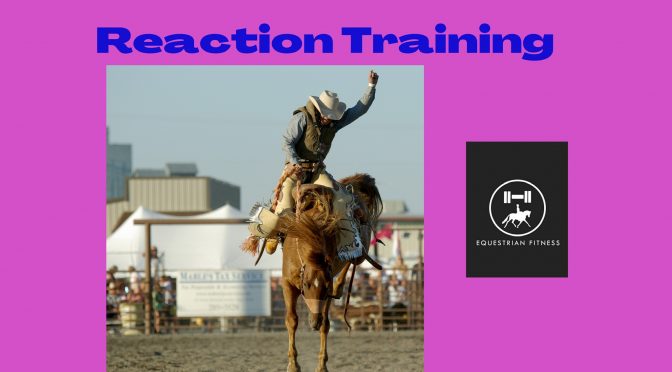
Reaction times are something that is looked at a huge amount in other sports but not so much in equestrian sports. Yet we all know that one minute you’re merrily riding in one direction then the next minute you’re facing the other way. If you’re lucky you’re still on board at this point! So, you definitely need good reflexes to deal with that!

It’s not just for the emergency situations though. It’s also when you’re trying to join movements together in a Dressage test, or jumping a course of fences. The faster your body is able to react to the changes required of it the more in balance you will both be and the clearer your aids will be.

Whenever I train reactions with my clients we have some fun with it.

It could be playing with the reaction ball (odd shaped ball that pings off in all directions) or we run in one direction then when I shout they change direction.

We also do weighted ball slams or throwing it against the wall.

I know we aren’t really doing Christmas parties this year but you could have a family game of musical statues or musical chairs and call it rider training.


Force Absorption

Force absorption is what your body is doing the entire time you are on a horse. Of course in reality your body is absorbing force when just walking around it’s just that on a horse it’s got an extra say 600kg of force underneath it to deal with. 

If you’re wobbling around on board, maybe you have a wiggly middle, a nodding head or you have to stiffen up to hold yourself, they’re all signs you aren’t absorbing the movement as well as you could be. 

Efficient Force absorption isn’t just so that you can sit and ride well. It’s also important to prevent injuries. 

A really simple way of looking at how your body absorbs movement is by sitting on a gym ball and gently bouncing. Can you do this whilst maintaining a stable but not stiff torso? Think of relaxed muscle tension. Once you’ve got this bounce a bit bigger.

A great body weight force absorption exercise is squat jumps. Starting from a squat, you jump up and land back in the squat. If you then wanted to progress you could add height by jumping onto and off a box. Make sure you land with a strong torso and bent knees still tracking over your feet.

A great weight based exercise is the Kettlebell Swing. This requires you to both create acceleration and then control it at the top to bring it back down. It’s like the biggest trot you’ve ever ridden!

Being able to absorb force makes you more stable which relates back to the exercise we did last week.

Balance & Stability

Last week I mentioned some areas to focus on for your own rider fitness.

As promised here is the first round of inspiration for you.

This weeks focus is balance and stability.

Stability requires a level of muscular strength. I’m not going to go into pure strength here I’m going to focus on the balance element.

A basic balance test is standing on one leg. 

Can you do this whilst keeping your pelvis level? Is it harder standing on your left or your right leg? 

Now try moving the same side arm or the opposite arm at the same time as lifting the leg. Can you still keep your pelvis level? 

You could then up the ante on this by trying it on a wobble board or wobble cushion. 

Or adding a band attached to a door around the standing leg or your waist so you have to resist the sideways movement.

Even trying to do this whilst turning your head or having a conversation can make it more difficult. Of course that’s the point as when you’re riding you want your balance to work whilst you’re also focusing on your horse, giving aids, possibly listening to your instructor. So you want your balance to work even when you aren’t focusing on your balance. 

Give these exercises a try and see how far you can get before you start to wobble.

Better Jumping

I don’t often cover jumping things mainly because most of my clients focus on flat work, but I do have the odd one that leaves the ground occasionally. 

However I watched a video recently that made me think about how the rider has so much influence on the quality of the horses landing, the get away and turn to the next fence and of course getting over it.

Landing from a fence requires your body to absorb a huge amount of force and it needs to be strong enough to do that. 

As you then start to pick up the pace again you need to already be back in balance to stay with the acceleration of the horse. Then particularly if you’re showjumping you will be making a tight turn to another fence.

Your horses ability to do this in balance and fast relies on the rider staying with him at every stride. 

Being able to do this can be the difference between 1st and 4th place at a competition as the margins for time can be so tight. If you shaved 2 seconds off because you were able to make a tighter turn or because you were able to pick up the pace faster after a x country fence that  could be a decider.

Also, most importantly in my opinion being able to stay balanced puts your horse at much less risk of injury.

Ok, I could talk about all the why’s etc forever but I’m pretty sure you’re already at the “so how do I do this” bit.

Work on yourself. 

  • Your balance and stability.
  • Your reaction times
  • Your force absorption 

Look out for future posts on some ideas on how to incorporate this into your off horse training. 


Weight down the thighs

When I’m working with someone on horse I will often ask them to put more weight through the thighs, perhaps imagine they are kneeling. The phrase/cue originally comes from Ride With Your Mind with Mary Wanless, however as I’m only ever focusing on how the riders body is working on the horse I don’t ever use a cue I don’t have an understanding of when and why I’m using it from an anatomy point of view. So I tested it and analysed what it did to riders (including myself) if they did it. 

The two most common reasons I use this cue are 

  • Instability 
  • Pain -often the knee but sometimes the ankle.

Now I’m not saying there shouldn’t be weight through the heel as we are originally taught  as there definitely needs to be a connection to the foot but if a rider lacks stability they will often push down quite a lot into the heel in order to try and create it; which then results in joints locking and becoming rigid instead of force absorbing. This then contributes or indeed causes a pain issue, or at best just doesn’t enable you to move with and communicate with the horse as well as you’d like to.

However if you bear weight through the thigh what you actually do is activate the muscles at the front and the back of the thigh and hopefully if done well the glutes too. So you’re instantly using some big muscle groups to help stabilise you further and in the case of joint pain give it a much bigger support system. 

A rider truly in self carriage has these muscles activated as they ride. They won’t be tensing and flexing with huge effort as if doing a workout but they will just be gently working away, supporting the body and enabling it to absorb the movement of the horse and move itself to give aids and accelerate and decelerate through transitions. 

If we expect self carriage from our horse we should expect it from ourselves.