Snack Size

I’ve been trying to add more strength training into my routine, however my body generally feels better if i do some cardio most days - x trainer, spin class, swim etc which means it’s hard to add in without over training.

Instead I’ve been doing snack size resistance workouts alongside my cardio.

I pick one 1 Upper Body exercise and 1 Lower Body exercise, or a couple of core exercises; then in a spare 5 or 10 minutes between clients I’ll do 10 of each aiming to do this 3 or 4 times across the day. 

This means I can fit in the equivalent of one big workout across the week without the overtraining feeling.

Perhaps you could use this to add in a workout across your day. I use weights but only because I have them nearby, you could do without my weights or using whatever you have to hand.

Some suggested pairings to get you started, but do whatever works with the space you’re in at the time.

Squat - Shoulder Press

Press Up - Forward Lunge

Plank Twist- V Sit

Side Lunge - Plank up down

I know it’s uncomfortable

People assume my clients are all fit, athletic folk……..98% of my clientele is already laughing reading this!

They aren’t. They are all amazing human beings though.

So many of them were completely new to my form of exercise other than riding! Some of them aren’t even currently riding for various reasons. 

Yet, that hasn’t stopped them from stepping outside their comfort zones and starting their journey’s to becoming more comfortable with exercise. 

It’s about getting started. 

It’s about working with someone who gets it

I know what it feels like to be intimidated walking into a new class or a gym.

I know what it feels like to not be able to do something, to struggle getting your body to participate. I understand that “rest in Downward Dog” is the words of a lunatic for a while in Yoga. 

Once upon a time you couldn’t do rising trot, I bet you barely get into trot now without just rising automatically-change your diagonal though…..

So, if you’re reading this and you’re thinking you should probably be trying to up your game to be the rider your horse deserves but it feels too far out of your comfort zone just take the first step.

Go to that new exercise class, join that gym, or close the curtains and do some squats in the living room. If you can just keep making that one step I promise it starts to feel more comfortable.

Also, lots of people on that class or gym will be feeling exactly the same as you do right now but like you they were brave enough to show up.

If you’re not the exercising out of the house type then my online programme is suitable for all levels, all you have to do is sign up and press play!

https://www.equestrianfitness.co.uk/online-classes/

New Beginning?

April marks the end of the first quarter of the year-Eeeeek! Which of course also means it’s the start of a brand-new quarter!

Springtime and Easter naturally lend themselves to new beginnings with the Farming community losing sleep over lambing and calving right now, and if you don’t have an Apex Predator Bella Cat at your yard then there will also be tiny hares hopping around your fields at dawn and dusk.

New life season means if you aren’t currently happy with the way yours is heading you can take this second quarter to act and re set those goals!

If you set goals at the beginning of the year, firstly look at those now.

How are they going?

If things need to change on those and they need to be reset start there.

If you still want to achieve those goals but you haven’t taken enough steps towards them, ask yourself why? Have you made excuses about lack of time, the weather etc?

Time to decide whether you really want to achieve it and if the answer is yes, it’s time to put in the work.

Ask yourself whether you could get up earlier, skip an episode of that box set or just be more efficient with your time at the yard-less talk more tacking up!

Do you need to work smarter not harder? Do you need to do 5-6 similar, vaguely planned schooling sessions with your horse or would 3-4 quality sessions give you better results in less time. Those spare evenings/early mornings could be spent working on yourself……

If those original goals are no longer right for you, let’s set some new ones.

Where do you want to be in 3 months? 6 months? 12 months plus?

What does it look like?

How will it feel?

What daily actions will you need to take to achieve it?

What changes will you need to make?

What will be your obstacles and how will you overcome them?

Do you want some help and accountability?

I’ve got a couple of spaces for online coaching where we can set your goals and keep you accountable every week to take action towards achieving them, navigating your obstacles, and celebrating your achievements with you along the way. Message me to get started and let’s see where you are by the next quarter!
Are you better than you think you are?

So much of what we do with our horses relates to how we feel about ourselves. 

If we don’t believe we are capable of achieving more or of learning new skills we may never push ourselves to try. 

A feeling I often see in my clients is “people like me don’t do that….” People like who? Those at the pinnacle of the sport are still only human they’ve just put more hours into their craft than us. 

So many of us don’t feel good enough.

That’s what I like to unravel in the gym. 

Those people who can’t learn new skills suddenly taking on new exercises in the gym as we’ve broken them down into manageable steps and all of a sudden it falls into place. 

People who swear they aren’t coordinated are suddenly doing tricky left hand right leg things. Ladies who didn’t lift weights are lifting significant weights because we started small. 

This new found confidence starts to transfer to other areas. Using the same approach of breaking things down into smaller steps new skills become achievable. 

If you feel like rider fitness isn’t for you yet you feel like your riding isn’t improving maybe it’s just a matter of starting smaller and breaking down the steps. 

Working with an expert can help so if you want to get working on your self improvement today let me know! 

What aids are you giving?

As you’re riding your horse you’re communicating with your seat bones. If you’re tuned into them you can give precise aids without looking like you gave any aid at all.

However as often we aren’t necessarily tuned into our seat bones they could be giving aids without us realising. Or if we are using them but aren’t necessarily fully tuned into exactly what they’re doing they could be doing different things right to left.

So, here’s a little exercise for you to try out on a gym ball.

Firstly sitting on the ball, can you feel which direction your seat bones are pointing? Forward, back, different each side? Ideally they should both be pointing straight down as if you could plug yourself in to the ball with them. 

Then imagine there are pencils on the bottom of them, draw a circle with them one at a time. Are your circles the same? 

Now, sitting on the ball imagine a set of buttons in front of you. Slide alternate knees forward to push the button-or start to move your seat bones as if you’re in walk on your horse. Are your left and right seat bones doing the same thing? 

How about in trot?

Then move on to Canter. If you’re on right canter just follow the canter with your right seat bone, how does that feel? What shape does it make?

Now try the left. Is that the same or is it different?

By this point you’ve probably realised you’re more asymmetrical than you thought…….

Think about how that impacts your horse, your riding and your saddle. Of course no horse and rider will ever be 100% symmetrical but being as close as you can get will have a huge impact on your riding aids, as well as your horses symmetry and the wearing of your saddle. 

What did you find when doing this exercise? 

Crunches for Core Training?

Often when I start training a new client they will have asked for better core strength. 

Then after a few weeks training I’ll ask them how they’re finding the training, what they are enjoying and what they may want to do more of. That’s when they’ll say-“ I want to work on my core more……”

Their training so far will have included things like Weighted Squats, Deadlifts, Over head press, Kettlebell swings………all of these movements require you to use your core! However they require you to use it as part of using your whole body so it learns to switch on whilst hip hinging, pushing, pulling etc. 

So much core training we see is using the abdominals in isolation either static or with very little movement across the rest of the body. That doesn’t transfer that well to sports performance; riding or otherwise!

Don’t get me wrong, I still include some of the more traditional core work in my sessions, classes etc but usually as a way to break down a breathing and recruitment pattern or to focus on ultimate control of small movements in the torso. It’s more accessory work than the main focus. 

The real “Core Strength” training occurs in the big compound movements when they are required to activate as part of a whole body stabilising movement pattern. 

When you ride you don’t use your abdominals in isolation. You use them alongside a stable pelvis and shoulders, force absorption through the whole body and perhaps small movements in the arms and legs. And you’ll hopefully be breathing throughout all of this too! 

So, it makes sense to train in a way that requires your core to work whilst performing other things such as a movement pattern, maybe force absorption and of course Breathing!

If you’re looking to improve your core for riding think about the whole picture in your training. Start with basic movement patterns such as Squat, Hip Hinge, Push Pull. Also consider Force Absorption, perhaps your reflexes and sure add in some abdominal work.

But don’t think you haven’t done a Core Strength session because you didn’t do a Sit up or a Plank!

Mastering your Body

As part of my work with clients I often help them understand what things are supposed to feel like when riding.

For example; the idea of your rein contact coming from your shoulder girdle and abdominals, or what your body needs to do to absorb the movement of a horse underneath you.

It can be hard to explain this whilst on a moving animal, particularly when it can be something that talented riders do instinctively. It takes a huge amount of body awareness to understand what the body is supposed to be doing whilst riding, which muscles are activating, which bits are lengthening and how you can make those things work better together.

Without blowing my own trumpet, that’s what I do. It’s my job to understand, analyse and explain all of those things to riders like you in a way you can easily grasp and then hopefully recreate that feeling when you’re riding.

Once you are aware of how your body can move or manipulate what’s going underneath you, suddenly things start to click into place; the impossible becomes possible.

Off horse training is about mastering and understanding your own body. If you can understand and control which bits of your to activate to create stability alongside which bits to release to create mobility you can fully use your body to communicate with your horse.

If you want some help mastering your own body let me know!

Staying strong the whole ride

This week I’ve been having a little fun with some of my 121 Clients holding a 2 point seat on some balance pods whilst trying to keep a steady contact on bands held as reins. With optimum time of the Cross Country at the Olympics being 7mins 45 that’s been the aim. To stay fairly still on an unstable surface, when if you try and use your hands for the balance the elasticity of the band will throw you off is harder than you think.

Although of course this doesn’t directly replicate a cross country round effort it does train stability and endurance of the muscles. I’m considering ideas of how I could add jumps in……

Whether you do Eventing, Dressage or just general hacking or schooling, riding well throughout requires stability and endurance of your muscles. This is slightly different (although not exclusively trained different) to endurance of your lungs.

If your stabilisers and your bigger muscles get tired mid ride it’s going to be hard to stay effective, and indeed safe right to the end of your ride. Tired muscles don’t perform as well, so they won’t be giving clear aids, or sitting as lightly or correctly. Secondly, tired muscles may not react as quickly to a spook, trip etc meaning you’re more likely to fall off!

As I mentioned training endurance of your lungs is different that doesn’t mean training you would traditionally do for that such as running, cycling or swimming etc isn’t effective for endurance of muscles; it totally is! So, if you like adding that into your training that’s great.

Regular resistance training is also great for improving muscular endurance.

However I like to occasionally add in some static muscle poses to test the endurance of muscles alone. Although riding can often feel like a decent workout (or it should if you’re doing it right!) you don’t actually move your muscles that much-although they are working quite hard.

You don’t have to be quite as silly as me and my clients with the balance pods and the bands etc, you can make it much simpler by doing things such as wall squats, a low free standing squat, plank, side plank or holding a split squat for increased lengths of time.

Breaking down the basics

I’ve been doing a bit more horse training lately. Mainly groundwork or basics under saddle with both my own ponies and a friends. I am by no means an expert on training horses but I tend to approach physical schooling problems with horses in the same way I approach training people.

How are the absolute basics or movement patterns? With my clients that’s how stable are they on single legs, can they isolate their shoulder blades, do they rotate left and right equally and can they Hip hinge and Squat.

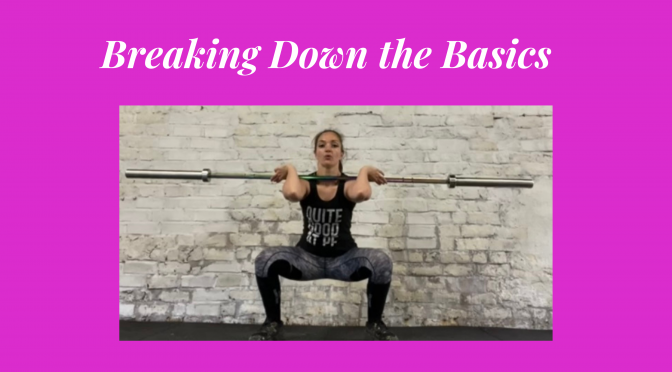
The Squat is one I’ve seen lots of riders struggle with. The squat is much more technical than it appears. It requires stability from the hips, knees and ankles and good control of the torso. 

This is why I break it down to into regressions depending on peoples’ ability. 

If someone struggles with control of their torso or finds Squats painful on their knees I start with Gym Ball Squats.

If it all goes wrong in the mechanics of the up and down (lacks stability) I use Bench squats. Just using the familiar motion of standing up and down like you would many times per day makes it easier to focus on the bits that need extra work.

Using plates under the heels can help people reach depth whilst they work on ankle mobility.

Once we’ve got a solid base we can do regular bodyweight squats. 

Then we can add weight with a Kettlebell/Dumbbell or a Barbell on the back or the front. 

After that it’s add more weight or add instability such as bands, wobble boards etc.

The point isn’t necessarily to get to the end point. 

We don’t all school our horses to get to Grand Prix, we school them to be the best athletes that can be. 

That’s how you should approach your own training. It’s doesn’t have to be about becoming an all out gym bunny or weight lifter, it’s just about making your body the best that it can be.


Lessons from Wimbledon

I’ve been watching some of the tennis this week and in between matches they have been showing cameras behind the scenes where players are warming up. The nerd in me found this bit way more interesting than the matches!

The players aren’t hitting balls and just playing tennis to warm up, they were doing a series of activation exercises clearly all specific to them. Things like fast banks rotations or arm pull overs designed to prepare the muscles for what they’re about to do on the court.

It got me thinking whether if you went behind the scenes before a Dressage competition or on Cross Country day would we see the same thing? 

Probably not. I’m sure you may find the odd rider doing a few stretches or activation exercises, but the majority will be getting straight on and focusing on warming their horse up. 

Of course if anyone ever says the horse does all the work you’ll strongly disagree-“have you ever tried to get half a ton of animal to follow instructions?” Riding requires you to do a lot of things with your body. So why don’t you prepare it for that before you get on?

So, what sort of things should you do to prepare your body for riding?

Think Seat - Activating your hips and glutes with some Crab Squats and Side Lunges

Rein Contact-Open your chest with some T Arm rotations then activate your back and shoulders with some scapular retractions or dumb waiters. 

Then add anything else that may be personal issues to your body such as opening up one side or stretching out a calf