Let’s Do The Twist

This week I want to look at lateral and rotational movement. We had a little look at this last week by adding a little twist into the flow but I want to address it more directly now.

I want to look at lateral bending – that’s bending to the side; and your spinal rotation.

Why do we need it? Turning, circles, staying on a line and for keeping us even on straight lines.

For lateral bend I am going to make this really simple. In a mirror, start standing up straight with your hands by your sides and then slide your right arm down your right leg.

  • How far does it go?
  • Does your elbow reach your hip?
  • Do you tip forward or back as you go?

Ideally your elbow should reach your hip and you should stay neutral as if you are between two panes of glass on your back and front.

Now lets’ look at your rotation. You will need a broom handle or similar for this-your schooling or lunging whip will do!

Sitting down with room around you to turn, put the pole over the back of your shoulders and hook your arms over the top. Now turn your torso to the right and then to the left.

First notice how it feels. Was it an effort one way more so than the other? Ideally you should be able to get about 35-45⁰ rotation. Do you think you managed that?

Also notice whether your hips tried to come with you as you turned, you should aim for them to stay neutral.

Also try lateral bend and rotation on your horse if it is safe to do so. Sitting in your saddle what happens when you bend to one side then the other? Can you feel what happens to your seat bones and/or hips?

Now try rotating just your rib cage and above to the left and then the right. Is one way easier than the other? Can you do it without taking your hips with you?

If you feel like you struggled with either/both of these the simple fix is to actually perform the test movements for repetition however make them nice and slow focusing on correct alignment even if this means the movement has to be smaller. Over time the movement will get easier and the range of movement will increase.


Are You Fully Functional?

So we have been focusing the past few weeks on common selected Flexibility and Stability issues.

Whilst this is really useful in ascertaining on how well your body moves and performs it only gives us an insight into the individual areas. In order to fully assess our function we must also look at how our body performs as a unit. I.e. how the shoulders, hip and ankles function when asked to move together perhaps in a single line or in fact in opposite directions. Good full body movement is the key to moving well all day every day as very rarely do we try and move just a single joint at a time.

When riding a horse we certainly don’t move just one joint at a time, in order to give a small leg aid we must engage the hips, knees and ankles and possibly the ribcage and shoulders to give the direction of travel.

There are loads of different tests we could do to assess how well your body works as a unit, many therapist will use what is known as a Functional Movement Screen. This involves performing various movements using the whole body, however it requires some set up and the keen eye of a Therapist to assess how you perform.

We are going to have a little fun with ours. I consider good movement and good riding to involve 3 things-Mobility, Stability and Proprioception (body awareness) usually if someone can move with these things they move and ride fairly well.

We are going to start with what is actually a very basic human movement that we learn as babies then as soon as we stand up we don’t bother with it again……Crawling. I’m not just going to ask you to crawl on your hands and knees we need to up the loading a little to make it more challenging. So you are going to get into a 4 point kneeling position and then lift your knees off the floor. From here move opposite pairs of limbs forward to crawl forward a few steps and then do the same in reverse to Crawl backwards. You want to keep your bottom in line with your hips-no cheating sticking it up in the air. This will assess your ability to move your hips and shoulders simultaneously and also your ability to co-ordinate your movement patterns i.e. the opposite arm and leg bit. The bulk of movement stability comes from your shoulders however the ability to keep your bottom down is in the most part down to the stability of your core/hips. Think about all the times you have given either a hand or leg aid and another hand and/or leg has moved as well-thus confusing the aid that you meant to give?

Now let’s have a look at how you get on standing up. This addresses the same things but with the added load of full body weight and more stability required from your hips. Start standing on one leg; lift the knee to hip height and the arms above your head. As you do this notice what happens to your back and rib cage? We want to aim to keep the rib cage stacked over the pelvis and the spine in neutral. Any deviation from this suggests a restriction somewhere along the chain. Take your hands to “Charlies Angels Gun” position arms straight out in front and then keeping hips level and forward rotate your rib cage to the opposite side of the lifted leg. I.e. if your right leg is lifted turn left. Now let’s see how that proprioception is. Take the leg from lifted in front to lifted behind you, take your arms out in front and then drop your back foot behind you to land in a split squat, your foot should be facing forward as you drop down then take the arm of the back leg and side bend towards the front leg i.e. right leg behind, take right arm over to side bend left. Now push back to one leg to complete!

Have a go at these and let me know how you get on, next week we are going to look at rotational

Movement patterns. This is the sort of movement pattern we would use on turns, circles and lateral work.


If you would like a thorough assessment of your Biomechanics, Flexibility and Stability with a follow up personalised plan to address any issues Cost £50. Hit reply to get yourself booked in.

I also have space in my Studio Classes where we have loads of fun performing rider specific exercises to help you ride better, with more body awareness, control and strength. I have 1 space in each of Tuesday and Thursday at 7.30pm. Cost £30 per month for 1 class per week. Studio is located at WN8 9QP. Hit reply to join us.

Stable Makes Able

Final part of this series-working on your stability.

If you did the stability tests from last week you will know which areas need work.

Shoulders.

Ok, there are few ways to work on shoulder stability, many of which involve the arms overhead and obviously this is how we tested them. However I want you to work on strengthening their effectiveness in the position most required by you-so we are going to work with arms in a sort of rein holding position and focus on retracting the scapular there. Basically if you can nail this it will form the basis for a stable and supportive rein contact for your horse.

You can do this as a basic version or if you have access to a resistance band you can use that to make it a little more difficult.

Start with arms out in front at shoulder height. Relax your upper shoulders and begin to squeeze between your shoulder blades and draw your elbows back into your riding position. Your upper shoulders should remain relaxed throughout. If you feel them popping up, go slower, and really squeeze your mid back and stick your chest out a little. I know this one is tough if you struggle with tense shoulders but I promise the persistence and results are worth it! Build up to 2 x 10.

Hip Stability. –

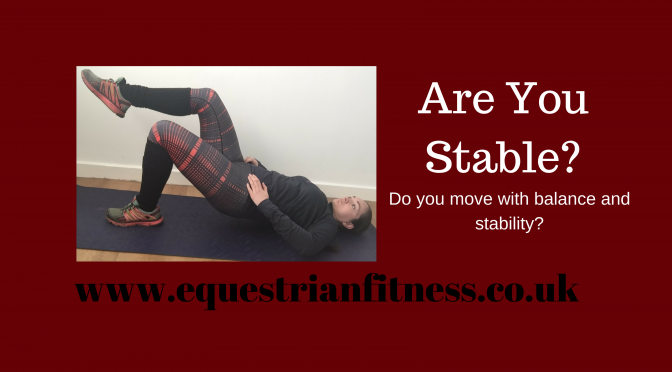
We are actually going to perform the test we did for hip stability as the fix. Start lying on your back, feet flat on the floor. Lift your elbows and put your hands on your hip bones to feel what they are doing. Go up into a bridge position and keeping your hips lifted and level lift alternate feet off the floor. If you can’t do this without falling over make the movement smaller and just lift your heel up keeping your toe down. Build up to 2 x 10 each leg.

For ankle stability, again there are many different ways of doing it, however as riders we spend a lot of time with feet balanced on the ball of our foot so that is where we will go with strengthening. Calf raises can be done on the floor, or off a step (better for a heels down approach) and on two legs or one-if you like a challenge! If you are on the floor you just lift your heel to balance on the ball of your foot and slowly go back down again. This can be done on two legs or one. If you are using a step, balance on the ball of your feet/foot and drop the heel down and then raise it up. Do this slowly and without bouncing. Build up to 2 x 10 each side if single leg.


Are You Stable?

So far in this little mini series we have looked at flexibility, measured it and then looked at ways to improve it. Now we are going to look at mobility. I have mentioned previously Movement Expert Gray Cook describes mobility as the ability to demonstrate flexibility under load. Basically do you still have a range of movement at a particular joint when it is asked to work.

As we looked at Shoulders, Hips  and Ankles for flexibility we are going to stick with them for stability.

Starting with the Shoulders.

It is actually quite difficult to self test stability of the shoulder so what we are actually going to do is look at its function pattern during movement. The point being if it is dysfunctional in a basic movement pattern it needs work.

Standing up, put one hand on the opposite shoulder. The free arm put out in front of you at shoulder height. Draw that arm back keeping it straight. If your upper shoulder muscle pops up under your hand you failed the test. Repeat on the other side.

Hips-

Lying on your back, feet flat on the floor, knees bent. Lift your hips into a bridge position. Put your hands on your hip bones and lift your elbows off the floor (no cheating). Engage your glutes and abdominals and lift one foot off the floor. Does either hip drop, or move around as you do this? You failed the test. Repeat on the other side.


Ankles-

There are lots of different ways to look at ankle stability as there are ligaments going in all directions, and again it can be difficult to completely isolate without the use of a therapist. However I am going to keep this simple and fairly functional, however I should mention if you failed the hip stability test you are more than likely going to fail this one too and it may be due to your hips not ankles. However if your hips were ok and you fail this, it probably is your ankles. If you fail both you should work on improving both as they rely on each other very much for good movement patterns.

Starting feet together stand on your tip toes . Now put on foot directly in front of the other and walk a few steps. Can you do it?


I will leave you with those and next week we will look at fixing your weak spots.


If you would like a full screening of your flexibility and stability, and a personalised programme to address any issues book in with me in the studio for a Biomechanics Assessment.

Fix Your Flexibility

Last week we tested your flexibility, so this week I want to give you some help on improving those areas you struggled with.

First, your shoulders and upper back. Wall Angels works to encourage you to open your chest and really use your scapulars which in turn improves their mobility.

Stand about 2-4 inches away from a wall and put your bottom and whole back and head flat against the wall. Start with your arms bent just below shoulder height. You should be able to feel your shoulder blades touching the wall-your aim is to be able to keep them touching the wall throughout this exercise. Start to raise your arms up the wall as if going to join your hands over your head, as soon as your scapula moves away from the wall go back down and start again. Build up to 2 x 10 reps.


Next up your hips. Now as we went though 3 different areas on the hips I have 3 different fixes depending on where you felt you needed work.

So if you remember we looked at the front of the thigh first. Here is a stretch that has a basic and more advanced version depending on what level you are at.

Start kneeling up and then put one foot out a good stride length in front of you with the knee bent. You can just bring your hips forward here if that feels like a deep stretch to you, or if you need to go deeper you can put your back lower leg up against a wall (or gym ball as I have done) Hold the stretch for 30-60 seconds

If your leg rolled in on the hip test you need to work on your inner thighs. Stat kneeling and take one leg out to the side as far as it with comfortably go. Put your hands out in front of you for support, and start to gently rock forward and back and then hold the stretch for 30-60 secs.

If your leg rolled out you need to work on your outer thigh. Start lying on your back, knees bent, feet flat on the floor. Cross one ankle over the opposite knee. And then take hold of the leg underneath and lift it up. Hold for 30-60 seconds.

And finally the ankles. Start kneeling and put one foot out in front of you and keep your chest low on top of the thigh. Keeping the heel of the front foot down use your body weight to press the thigh gently forward and back and then hold for 30-60 secs where you feel a stretch. You may need to experiment with the position of your foot.

Get to work on these before we start looking at your stability next week!


I still have space for 121 clients in the studio, so hit reply if you want help hitting your goals this year.

How’s Your Flexibility?

After last week’s discussion about what “sitting better” actually entails let start with addressing your flexibility.

We will look at some key areas and I will take you through some self-tests that you can do to find out where you maybe need to do some work.

Remember these are just starting points, don’t be disheartened if you don’t get great results, I’m here to help you improve them. We just need an idea of where you are starting so that will be able to measure how much you have improved.

Here goes then. Obviously this would be ideal if you could get a friend to help with the readings and take pictures but doing them alone is fine and just writing notes on how things felt etc. will be equally beneficial.

Upper Back/Shoulders.

Lying on your back, knees bent feet flat on the floor. Find your neutral spine and have your hands down by your side. Now raise one arm above your head whilst maintaining neutral spine.

  • If you can touch the floor behind you-Great work you have excellent upper back and shoulder mobility.
  • If your back begins to arch before you touch the floor then your upper back and shoulders need some work.


Hips-

You will need a sturdy table for this, or you could stack up some bales of hay or shavings. Anything that you can safely lie on without your feet touching the floor. A friend to help and validate the results is useful is possible but if not you will get a good idea of how you score on your own.

Sit yourself with your seat bones on the edge of the table. Bring one knee into your chest and lie back with the other leg still hanging off the edge.

There are three things to look for in this test.

  1. Is the hanging leg lifting off the table, staying level with the table or does the knee drop lower than the table? If it does not drop below the table your Psoas needs work.
  2. Is shin hanging less 90⁰? Hanging at 90⁰ or is it feely swinging past 90⁰? If it does not swing past 90⁰ your Quads require work.
  3. Is the thigh rolling in or out or has it stayed straight? If the thigh rolls in your adductors need work, if it rolls out your abductors need work.


Ankles-

Stand about 10cm away from a wall. Feet flat on the floor. Bend one knee towards the wall keeping the heel down and ensuring that the ankle does not roll in or out.

  • If you can touch the wall-Great you have excellent ankle mobility!
  • If you were nowhere near the wall-You need some work on your ankle mobility!


I want to sit better

What does “I want to sit better” mean?

I ask my clients and class members often what their riding goal is and very often the answer is “I want to sit better on my horse”.

What does that even mean? Sit better how?

Do you want to have better alignment –be sat up straight as the phrase goes?

Or do you want to feel more stable in your seat, move around less in the saddle?

Maybe it’s both, maybe they are both the same thing. Answers on a postcard……

Firstly, what is the ideal riding position?

Well it is often described as being in a neutral spine, thighs at about a 45⁰ angle, heel parallel or lower with the vision of a straight line from the ear, shoulder, hip and heel. The elbows should be slightly forward, bent but relaxed.

There should be equal weight and muscle tone through the body front to back and left to right.

Ok got it, now get into that position and maintain it whilst on a moving animal……..

So, how do we first achieve this position and secondly how do we maintain it?

In order to achieve it we must have adequate flexibility and movement in our spine, hips and ankles and to maintain it we must have stability throughout all of our joints but most notably our spine, shoulders, hips, knees and ankles.

Flexibility and mobility are the foundations of our basic movement patterns however in order to do these patterns well we need the stability to support the structures as we move.

I think most people are aware of what flexibility and mobility are. It is our range of motion at muscles and joints.

However what is stability? It is certainly not stiff, restricted movement.

There are several variations of the meaning of stability. The most relevant are.

  • The strength to stand or endure
  • The property of a body that causes it when disturbed of equilibrium or steady motion to develop forces or movements that restore the original condition
  • Movement specialist Gray Cook describes stability as “The ability to demonstrate our flexibility under load.”

I think all of these are relevant when riding. Obviously riders need the strength to endure the force of the horse beneath them and they also need to be able to maintain their equilibrium (position/alignment) under constant disturbance. The Gray Cook definition I think can often be misunderstood. As flexibility does not necessarily mean doing the splits. The very act of sitting on a horse in neutral spine requires flexibility in the hips and spine. The ability to maintain this whilst enduring the force underneath from the horse is stability. You may have incredibly flexible hips on the ground but once on a horse they feel tense, tight or wobbly-this is lack of stability not lack of flexibility.

So, back to my original point. You say you want to sit better. I say you need to look at first your flexibility and then secondly your stability.

You must first have the flexibility to achieve the alignment and then once achieved the stability to maintain it on a horse.

Tune in next week when we look at some self assessment flexibility tests.


Just 4 spaces left for 1 2 1 training at the Studio so get in touch if you want some help to achieve your goals this year.

Small Steps to Big Goals in 2018

I hope you had a great new year-or it may have been as un rock and roll as ours!

I do love a new year in itself though. I love the idea of a fresh start, new beginnings and the expectation of where 2018 might take us.

After suggesting you take some time to reflect on 2017 I hope you now have a clearer idea of where you want 2018 to take you and your horse.

Of course nothing is ever guaranteed with horses but hey we can start with a positive attitude can’t we!

Without wanting to stomp on your enthusiasm though I want you to really think about your goals this year and what it will take to achieve them. Let’s be honest if you are currently at Prelim it’s unlikely you will be at PSG by December but hey you could be at Novice or even Elementary by then so closer to that dream than you are right now.

I like to work backwards making a plan of all the small steps along the way that I will need to complete to get me to the end goal.

This way the goal doesn’t seem so big. For example I spent 2017 backing one of my ponies. Obviously the final goal being to be on board walking and trotting without help.

I broke this down into the tiny steps from lunging without tack right up to tack on and then getting on, walking being led and so on. To be honest we are only just there by the skin of our teeth but we hit stumbling blocks along the way (we had nowhere to ride at all whilst the arena was built…..but I now have an arena!) so that slowed us down, but we have got there and I managed to stay focused because I could see all the milestones we had already hit on our journey and that made me positive we could hit the others. Even if we hadn’t got to riding independently we would still be much further on our journey from the not having even worn a bridle this time last year.

In 2018 I want you to make a plan of small steps you can keep taking towards that goal this year and don’t be surprised if at the end of the year you have achieved big things!

I would love to hear what your 2018 Goals are, hit reply and let me know what they are!


PS: I am have space for just 5  1 2 1 Personal Training Clients at my studio this year, so if 2018 is the year you make yourself the best Equestrian Athlete you can be for your horse get in touch!

Where Did 2017 Take You?


I hope everyone had a lovely Christmas and had at least a small break to spend some time with your horse.

I just want to ask you to spend some time over the next few days reflecting on how 2017 has been for you.

Do you remember those goals you set right back in January? How did you get on with those?

Did you smash them? Did you maybe make some progress but you aren’t there yet? Or did you write them off mid-year and tell yourself next year?

Perhaps your goals have changed?

Personally some of my goals from 2017 are nowhere near at fruition, some of them have changed completely but some have also made great progress. I have opened my studio, set up my classes, worked at some Horse Camps and backed at least one of my ponies-oh and lifelong dream of having an arena came true!

I’ve achieved some great things both personally and professionally this year (I’m not just showing off bear with me!) but along the way there have been ups, downs, twists and turns, yet because I had clear plans no matter how small the steps I have kept moving forward and this has given me a head start and clearer vision of where I want 2018 to take me.

So I want you to reflect in the same way:

  • What went well this year for you and your horse this year?
  • What didn’t go so well this year?
  • Where would you like to be this time next year?
  • What steps are you going to take to get there?

Then it’s time to start planning 2018!

I’d love to hear your 2018 Goals riding and fitness related or otherwise; share them with me and we can be each other’s accountability in 2018.

Ok, you have most probably almost all finished for Christmas today-literally no work being done in any offices today!

I know those of you that are off work over Xmas will want to spend extra time with your horse and riding. However I’m also sure many of you will be planning 2018 goals and in particular your own and your horses training next year.

For your horse I’m certainly no expert there but you? Well that’s who I’m interested in whipping into shape for 2018!

I thought what with all the excess food, drink etc. that we have over this period now would be a great time to add in some short workouts to be both damage limitation on the weight factor and also a little head start on the new year fitness.

So here are 4 short circuits you can do to keep you ticking over whilst time is tight- they are all just 4 minutes long so there are no excuses for not finding the time!

Also, those that know me will know I’m still on rehab training for my shoulders and hips so filming these for you was seriously tough for me-don’t let me down by not doing them!