Confidently Fit

This week I presented a demo at White Hill Stud. Also speaking was Camilla Henderson –Sports and Performance Consultant. She gave a talk on Rider Sports Psychology-It was really good and if you are interested in that sort of thing you should check her out.


Anyway, one of the things she talked about affecting confidence was competence and fitness.

This resonated with me on a number of levels. Once of course being that fitness is my business but also because from personal experience.

It stands to reason that if you feel weak and wobbly on your horse you are more likely to feel insecure. Also if you feel uncoordinated and not in control of your body this can lead to feeling unsafe.

If this is you then improving how your body performs is definitely a good place to start.

Fitness for riders can be many things dependant on their particular equestrian discipline and of course their own wants and needs.

A few key areas to look at are:

  • Flexibility and Mobility. Having a good range of movement from head to foot ensures your body is able to function uninhibited and without restriction. As riders we do not need extreme flexibility like a gymnast, but any areas where you do not have an average range of movement needs addressing even if I’d does not seem to directly affect your riding. This is because we are joined from head to foot via muscles, tendons and fascia and a restriction in the left foot could possibly affect the function of the rider shoulder and vice versa and all its variants.
  • This refers to balance and muscle strength. Again this does not need to be extreme Strongman style strength but good muscular tone enables us to have better control of our bodies reaction to the horse underneath us and enables us to better hold our position without force or tension.
  • This is a fancy way of saying body awareness and co-ordination. If alongside strength you are able to properly control your body and its reactions this will enable you to feel infinitely more in control and therefore safer as a result of it.
  • Cardio fitness essentially refers to your lung capacity and in simple terms your ability to keep going without passing out! In terms of riding the fitter you are the longer you will be better able to breathe and transport oxygen around your body for energy, but also the longer you will have the physical capabilities to keep giving clear aids and remain in control of your body and also keep a clear mind. The level and type of cardio you require will be different depending on your particular discipline. E.g. a Showjumper needs fitness for a short, fast round like a sprinter, whereas a Cross Country eventer needs fitness for more of a marathon style event.

So, if you do feel that your body needs a little improvement to help you improve in the saddle I hope this has given you an idea of where to start.

If you would like more specific help I offer 121 in person and on line coaching so get in touch!
 

You won’t even notice it’s exercise

Ok, so last week we talked “Car aerobics”

This week I am continuing the theme of things you can do off horse to improve your alignment and body awareness on horse without really doing any “proper” exercise.

I think the easiest way to incorporate sneaky exercise in is to make it fun and easy to fit in.

For this I recommend some props though.

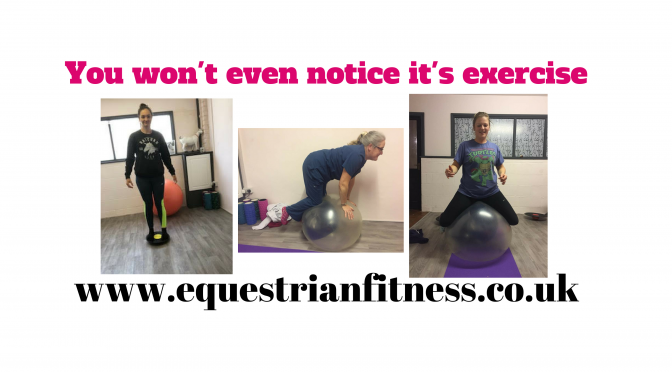
Most popular with riders is a gym ball.

I know it can be a bit cumbersome but having one all blown up and ready to go at home means you can hop on for 5 mins whenever the mood strikes you.

If you work from home using it as a desk chair is a super-efficient way to use it. I actually find it way more comfortable than an actual chair now, and it means I fidget constantly whilst I’m on it.

You can just sit on with your feet on the floor. This in itself makes you sit up straight and use your core muscles. You can try lifting one foot at a time or if you are really strong both feet!

I also like to sit astride it (as if sat on a horse in a dressage saddle) to stretch the front of my hips out-absolutely glorious when they feel tight.

You can of course do all of these things watching TV. So you can pop your favourite soap, drama whatever on and spend say half an hour watching it whilst sitting on a gym ball trying to lift your feet and stay balanced or, kneeling on all fours or kneeling up (carefully! You don’t want to explain your concussion injury was as a result of falling off a gym ball in your living room!)

All of this will massively improve your body awareness and over time your alignment (when it’s good you will stay on) and your core stability.

Slightly less cumbersome to have around the house is a wobble board. These can be bought fairly cheaply online and don’t take up much space. Just standing on one requires good alignment and stability. Try taking phone calls or sending texts/emails whilst stood on it, when you get really good try standing on one leg. Do squats on it during the ad breaks. Get your partner involved and throw a (soft) ball to each other stood on them.

These can all sound like kind of daft suggestions when you compare it to the strength and conditioning programmes you may see event riders doing, but unless heavy weight training is something you want to do then that kind of training isn’t going to work for you.

Just trust me on this one and try some of these out for yourself and watch your body awareness and core stability improve massively without you even noticing you’ve taken up an exercise programme!


Riding Life Hacks and Car Aerobics

Isn’t it frustrating when life, the weather, missing shoes or lameness get in the way of you regularly practicing that riding issue you’ve been determined to crack.


A while ago I read a book called ‘The Talent Code” by Daniel Coyle. In it he talks about how people gain the skills to perform activities such as kick a ball or play an instrument. It is all down to something called Myelin. In simple terms Myelin is the fibres that attach to our nerves to make them send the messages to the muscles to make them do what we are asking. So in order to kick a ball like a premiership footballer you would need to repeatedly kick the ball with the aim being to gain the same power and accuracy in order to build up the necessary myelin fibres to be able to do it.


Now I can hear you thinking “well that’s the point, I was practicing every day and then I had to go away for work, or my horse lost a shoe….” well here comes a little life hack-Myelin doesn’t actually know if you are on your horse or not, it just knows what muscles you are trying to move where.


So inspired by my friend who is a regular at life hacking riding practice into driving the car and work meetings-(or she might just have worms) here are some things to think about that you can do whilst doing other every day activities.


Whilst driving the car or sat in a meeting

  • Can you feel both your seat bones equally?
  • Is your front and back equal length?
  • Are you equal left to right?
  • Are your upper shoulders relaxed?
  • Can you feel a slight retraction of your shoulder blades supporting your arms as they hold the wheel?

These are all postural requirements of riding that you can train your body to do when you are not on a horse, then when you are back on board it will be second nature!


Give it a go this week and see if you can feel the difference when you ride from all that extra practice!