The same principles apply

Whatever your chosen Equestrian discipline they all require the same fundamentals from you as a rider.

Yes, there are differences in your position if you’re doing Dressage as opposed to Jumping, however there are many principles that remain the same whatever actual position you may be in.

  1. Straightness. Whether trotting the centre line or approaching a fence, being able to ride straight makes a huge impact on how successful that will be. Obviously in Dressage lack of straightness will affect your marks. When jumping, the line to the fence can have an impact on whether you clear it and then the line following landing sets the success for your line to your next fence.
  2. Stability and Self Carriage. The ability to support your own body weight gives your horse the space to manage his own balance. If you’re unbalanced your horse has to manage your weight as well as his own. If your horse is a little unbalanced being able to support him with your own stability can help him to achieve his own balance with time. Again, the ability to remain stable over a fence makes the job a lot easier for your horse, as well as stability being able to hopefully keep you out of trouble if it goes a little awry.
  3. Proprioception. This is just a posh way of saying body awareness. It’s really helpful when riding to have good awareness of what your body is actually doing.  For example, if you ask for go with your legs but say whoa with your hands that’s not a clear aid to your horse. Or perhaps you’ve no idea you always slide your left leg further back than your right and it’s affecting your Dressage scores. A good level of body awareness can help you identify and then address these asymmetries.
  4.  Shock Absorption. Riding of any style requires your body to absorb the movement of the horse underneath you. In flatwork this enables you to move with the horse, maintaining good, relaxed stability.  Over a fence this enables you to land well and in balance. This has two benefits; firstly in preventing you from distorting your horses balance on landing and secondly setting you up well to ride away from the fence and possibly onto the next one. It is also vital for helping you ride pain free. A body that isn’t able to  absorb the movement underneath it will overuse some muscles and under use others. It will also place more strain on the joints and ligaments again potentially causing pain.

These are the things that whatever your chosen discipline you should be considering in your off horse workouts.

Are you Symmetrical?

I’m pretty sure you know that Symmetry is super important for your horse, so I’m sure you also know it’s important for you as a rider too.

Your own symmetry affects how your weight is carried by your horse and how effectively you give aids.

That asymmetry will affect your horses’ symmetry and therefore his way of going.

If he’s falling in on one rein or always getting a better score for movements one way than the other that could be down to you.

We all know we have a better rein, but do we ever really address it?

Perhaps you aren’t sure which leg is the strongest?

Or you do but you don’t know how to fix it?

Training your body off horse is an effective way of addressing asymmetry as patterns can be spotted and then addressed on the ground which will more than likely be representative of what is happening on when you ride.

Here’s a couple of exercises to try to both identify and then help to correct asymmetry in your lower body.

Standing on one leg-Surprisingly you might find one leg easier than the other!

Single Leg Bench Squats. Standing up from a seat on one leg is firstly more tricky than you think, secondly it’s a great way of training a weaker leg.

Give them a go and see if with practice you can even yourself up.

Nicola x

Staying strong the whole ride

This week I’ve been having a little fun with some of my 121 Clients holding a 2 point seat on some balance pods whilst trying to keep a steady contact on bands held as reins. With optimum time of the Cross Country at the Olympics being 7mins 45 that’s been the aim. To stay fairly still on an unstable surface, when if you try and use your hands for the balance the elasticity of the band will throw you off is harder than you think.

Although of course this doesn’t directly replicate a cross country round effort it does train stability and endurance of the muscles. I’m considering ideas of how I could add jumps in……

Whether you do Eventing, Dressage or just general hacking or schooling, riding well throughout requires stability and endurance of your muscles. This is slightly different (although not exclusively trained different) to endurance of your lungs.

If your stabilisers and your bigger muscles get tired mid ride it’s going to be hard to stay effective, and indeed safe right to the end of your ride. Tired muscles don’t perform as well, so they won’t be giving clear aids, or sitting as lightly or correctly. Secondly, tired muscles may not react as quickly to a spook, trip etc meaning you’re more likely to fall off!

As I mentioned training endurance of your lungs is different that doesn’t mean training you would traditionally do for that such as running, cycling or swimming etc isn’t effective for endurance of muscles; it totally is! So, if you like adding that into your training that’s great.

Regular resistance training is also great for improving muscular endurance.

However I like to occasionally add in some static muscle poses to test the endurance of muscles alone. Although riding can often feel like a decent workout (or it should if you’re doing it right!) you don’t actually move your muscles that much-although they are working quite hard.

You don’t have to be quite as silly as me and my clients with the balance pods and the bands etc, you can make it much simpler by doing things such as wall squats, a low free standing squat, plank, side plank or holding a split squat for increased lengths of time.

Shoulder Control

I often talk about Shoulder stability for riders.

It provides two benefits.

  1. It provides stability to the torso as a whole-it’s part of what you’d think of as your core.
  2. It provides stability to your rein contact.

The problem is many of us spend our days hunched over either at a desk, driving or sweeping the yard. This leaves the muscles of the back and shoulders long and weak. This means when we want to use them on horse they aren’t strong enough to respond.

When I work with riders I will ask them to retract their shoulder blades and many of them have no idea how to do that without using the muscles of the neck or chest. This means they lift their shoulders and tense rather than activate the muscles of the shoulder girdle that provide the stability.

So before we can even think about training the shoulder girdle we have to gain some connection from the brain to the muscles to allow us to activate them without tensing.

I start with Shoulder retractions. To do well this exercise is actually quite tricky.

With your arms out in front of you, draw your shoulder blades back and together without moving your head, neck or chest. Your shoulders shouldn’t pop up at all and your arms stay straight and will just move back a few inches.

Once we have got that mind -muscle connection we can move on to control of the shoulders whilst moving the arms. 

Do the same shoulder retraction, hold the shoulders down and together then bring the elbows back and then forward again without losing the shoulder connection. You can then add more movement to the arms, maybe elbows in and sending the hands out, then hands up and shoulders down. 

If you then want to progress your shoulder strength and stability there are some great exercises you can do with very simple equipment.

Add a band to your retractions and other movements to add resistance.

Then you can make this a Bent Over Row using a weight or band and recruiting the legs and rest of the torso to test your shoulder control as part of a full body position.

Windmills are another great exercise for shoulder stability that can be done with a Dumbbell, Kettlebell or just a bottle of water. 

https://youtu.be/6pRLnq8wF1E

There are loads of ways to make your shoulders stronger but whichever exercises you choose it’s super important that you can control the recruitment of the shoulder blades.

Breaking down the basics

I’ve been doing a bit more horse training lately. Mainly groundwork or basics under saddle with both my own ponies and a friends. I am by no means an expert on training horses but I tend to approach physical schooling problems with horses in the same way I approach training people.

How are the absolute basics or movement patterns? With my clients that’s how stable are they on single legs, can they isolate their shoulder blades, do they rotate left and right equally and can they Hip hinge and Squat.

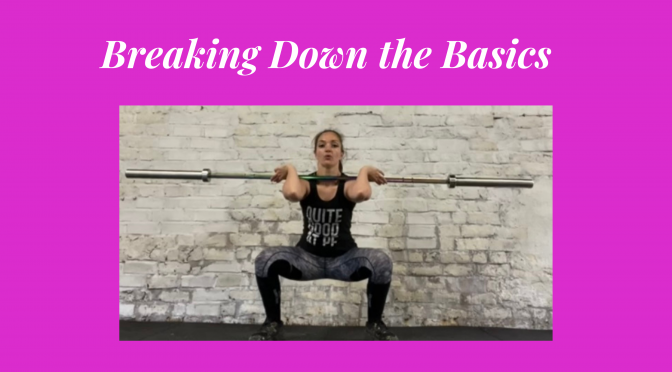
The Squat is one I’ve seen lots of riders struggle with. The squat is much more technical than it appears. It requires stability from the hips, knees and ankles and good control of the torso. 

This is why I break it down to into regressions depending on peoples’ ability. 

If someone struggles with control of their torso or finds Squats painful on their knees I start with Gym Ball Squats.

If it all goes wrong in the mechanics of the up and down (lacks stability) I use Bench squats. Just using the familiar motion of standing up and down like you would many times per day makes it easier to focus on the bits that need extra work.

Using plates under the heels can help people reach depth whilst they work on ankle mobility.

Once we’ve got a solid base we can do regular bodyweight squats. 

Then we can add weight with a Kettlebell/Dumbbell or a Barbell on the back or the front. 

After that it’s add more weight or add instability such as bands, wobble boards etc.

The point isn’t necessarily to get to the end point. 

We don’t all school our horses to get to Grand Prix, we school them to be the best athletes that can be. 

That’s how you should approach your own training. It’s doesn’t have to be about becoming an all out gym bunny or weight lifter, it’s just about making your body the best that it can be.


Lessons from Wimbledon

I’ve been watching some of the tennis this week and in between matches they have been showing cameras behind the scenes where players are warming up. The nerd in me found this bit way more interesting than the matches!

The players aren’t hitting balls and just playing tennis to warm up, they were doing a series of activation exercises clearly all specific to them. Things like fast banks rotations or arm pull overs designed to prepare the muscles for what they’re about to do on the court.

It got me thinking whether if you went behind the scenes before a Dressage competition or on Cross Country day would we see the same thing? 

Probably not. I’m sure you may find the odd rider doing a few stretches or activation exercises, but the majority will be getting straight on and focusing on warming their horse up. 

Of course if anyone ever says the horse does all the work you’ll strongly disagree-“have you ever tried to get half a ton of animal to follow instructions?” Riding requires you to do a lot of things with your body. So why don’t you prepare it for that before you get on?

So, what sort of things should you do to prepare your body for riding?

Think Seat - Activating your hips and glutes with some Crab Squats and Side Lunges

Rein Contact-Open your chest with some T Arm rotations then activate your back and shoulders with some scapular retractions or dumb waiters. 

Then add anything else that may be personal issues to your body such as opening up one side or stretching out a calf


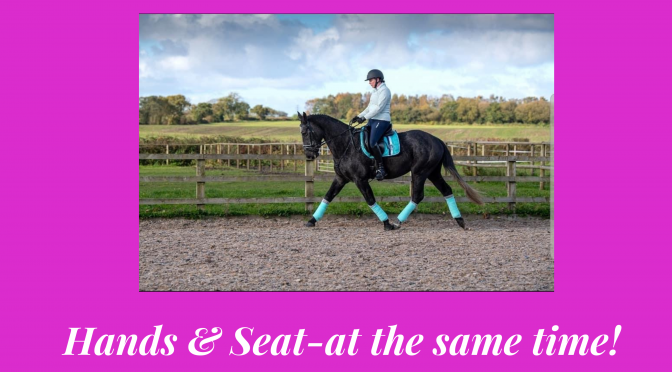
Hands and Seat……at the same time

When we ride we ask for both stability and mobility from our bodies.

We want stable hips, middle and shoulders. Yet we want softness from our ankles, knees, elbows and hands.

For me the biggest challenge is maintaining stability in the rest of my body whilst keeping it in my shoulders and keeping my hand and elbows soft.

I can do it if I’m just focusing on that area but not if I’m trying to use the other bits too. It’s so much to think about!

So I have to train it to get better.

In my regular training things like Deadlifts where I have to use my lower body to lift the weight whilst keeping my middle stable, my shoulders retracted whilst my arms stay relaxed.

Kettlebell swings which require the power to come from the hips, the torso remains stable and helps control the movement whilst the arms remain soft.

I also like to do some more rider specific exercises.

Rising Trot Squat -trying to get soft elbows and still hands.

I also like Split Squats with the arms going forward and back with the lift and lower of the squat.

Something I’ve also been trying out is sitting trot on a gym ball again trying to get soft elbows to absorb the movement but still hands for the contact.

Half Squat position whilst doing a banded row encourages me to stabilise my body and retract my shoulder blades. To make it harder I do the Squat so I’m moving up and down sort of like a rising trot whilst still trying to keep the movement coming from my shoulders keeping my arms soft.

I’m still way off being good at this so please excuse the video-these are my best efforts for now! Hopefully with practice I’ll be able to report back in a few months with some better ones!

https://youtu.be/e4D-QolatGw

Core……Set Training

In proper medical anatomical terms the “Core” isn’t really a thing. However it is a term that most riders recognise as a thing, and if you ask them where it is they will usually point at their abdominals. 

If that’s you, you’re not wrong! The abdominals are very much a part of what we would call the core. However it also emcompasses other muscles around the waist and back too. So really the core is a wrap around of muscles kind of like……..a Corset! Ponders whether that’s where the term came from?

That is why just doing a bunch of sit ups won’t fully strengthen your “Core.” You’ve got to Strengthen the sides and back too! 

Then to have it fit to ride you want it pliable, able to move , absorb force without becoming stiff and able to maintain stability whilst the limbs move independently of it. 

This is why with my Weight lifting clients rarely do any traditional looking Core training. We do full body exercises such as the Barbell Squat and Deadlift which require stability of the torso whilst moving limbs under a load. 

When we do “Core” work without equipment such as in my Classes or Online Programme we will mostly do them with movement of the torso or the limb; or sometimes both. 

Here’s some examples of my core stability training whilst moving limbs. Bird dogs -regular and lifted, Deadbugs - Regular and Double.Mountain Climber Straight and Across, Side Plank Lift and Leg Lift.


Why Yoga?

Why is Yoga beneficial for riders?

Yoga is great for :

Switching your brain off, unwinding and relaxing. Let’s be honest horses can be stressful. Add into that work, families etc and it can sometimes all be a bit overwhelming. Taking some time to switch off can be hugely beneficial to your mental well being and resilience. 

It can teach you to focus on both stillness and precise movement of your body. Being able to switch off and fully focus is a huge asset to your riding and Yoga is a great way of practicing that whilst tuning in to how your body reacts to signals from your brain and different movement patterns. If you can fine tune this off horse it will be a whole lot easier on horse. 

You learn to recognise your own movement patterns and asymmetries and can work to improve them. If you don’t know what your body is doing when you ride you have no way of correcting it. If you don’t know your left is different from your right you won’t take steps to improve it. Recognising these things in Yoga means your both feeling and addressing them ready to put into practice when you ride. 

Yoga combines mobility, flexibility and stability. Which are all required not only to be a good rider but also to help prevent injuries and make you feel good day to day. 

I utilise Yoga with my 121 clients, in my classes and we do a weekly yoga session in my online programme. 


Marginal Gains

There is a phrase used in Triathlon “marginal gains”

Basically if the right tri suit, helmet, bike frame, trainers etc made you even the tiniest percentage faster you do it because that’s a marginal gain and added to all the other marginal gains will hopefully give you some big gains overall.

Riding is similar in that respect.

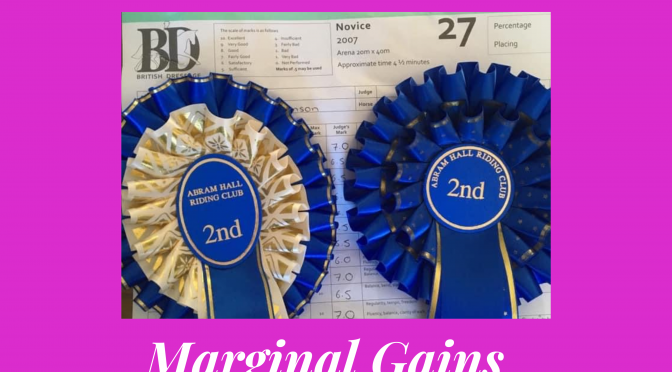
Dressage competitions can be won and lost on the smallest of percentage. There could be a huge difference in your placings for getting an 8 or 9 for certain movements so those little extra marks -those marginal gains can make all the difference.

Jumping is the same.If you’re against the clock the smallest second or the tiniest rattle of a fence can win or lose a competition. If being able to ride a tighter line knocks of a second thats a marginal gain that could make a difference.

Most of us are on board with the idea of making tack choices to make our horses just that tiny bit more comfortable, able to move better etc. They’ll have physio, massage pads etc all with the view to helping them perform even the tiniest bit better.

Perhaps you’ve even looked at the difference your boots, gloves breeches etc make to your performance.

What about your own personal performance? 

How many marginal gains do you think you could add if your reactions where faster, if your aids where a little sharper or you were a smidge more symmetrical?

That’s where I come in. 

I’m not really known for massive transformations with my clients. It really is about the marginal gains. 

It’s about being a little more symmetrical in your left and right hips.

Being a little more stable in your lower leg.

Having a little more control of your upper body over a fence.

Being able to rebalance quicker if it gets a bit messy.

These are the things I help my clients with in their off horse training. We do exercises to make them aware of and improve their symmetry. We improve their reactions, stability and control with off horse training alongside some tips and tricks for in the saddle.

These things are difficult to quantify with data, and often difficult to see as a before and after. Its just chipping away making tiny improvements along the way all adding up to bigger improvements over time. 

When you then take all these little improvements to a competition its a series of marginal gains that hopefully add up to marginally better score. That could be 2nd to 1st or it could be just a bit less rubbish than last time, wherever you’re at it means you’re inching forward bit by bit. 

What do you struggle with that with work could be a marginal gain?