Planning Winter Training

No matter how many years it has been since I left school (a few….) September always feels like a fresh start.

Maybe it’s because it’s also the switch over from summer to autumn so the nights get darker, the weather gets colder and with that comes a change of routine for riding and fitness sessions.

I think it’s a really good time to sit down with a pen and a diary, planner, piece of paper etc. and make a plan of how your training is going to look for you and your horse from now until the end of the year. (Without causing alarm there are just 16 weeks left of 2018!).

For your horse:

  • What activities will he be doing? If he’s not likely to be out competing etc. maybe you want to give him a break, or if you have some winter competitions planned how fit do you need him to be?
  • What facilities do you have? If you have an indoor then time and weather may not be a problem, but does your outdoor have lights? Maybe you don’t have an arena and will be limited to hacking in daylight hours. Make a plan based on the fact it will be dark in the mornings and evenings and it may well be wetter and windier.
  • What do you want to work on? Have you struggled with a particular issue out competing this summer? Make this time your chance to really nail it and plan the exercises, schooling sessions etc. that you will use to help you overcome it.
  • Get your trainer involved in your goals so they can be best advised to help you when training you. If necessary also get your saddler, vet and horse bodyworker on board to help you along the way.

Of course we all know with horses you can make a plan and the next day you’re phoning the vet and ripping the plan up! However instead of falling at hurdles along the way go back your plan, regroup and amend as necessary. For example we had spells over summer when the arena was too soft to ride on, so instead I did groundwork with backwards, sideways and walking over poles. My original plan was work to get my horse using his back end improving his muscle tone so we still achieved some of those things just in a slightly different way so that when I got back on we hadn’t regressed at all-in fact I think it helped immensely.

For you:

I personally feel that autumn/winter is the perfect time to really work on your on fitness, balance, symmetry etc. As you are likely to be riding a little less, and the dark nights mean you tend to spend less time socialising at the yard so more time to focus on you!

  • What activities do you need to be fit for? There is difference in being fit to go a full days hunting to be being fit for a Dressage Test.
  • How fit for this activity are you currently? If you are feeling very unfit then start slowly and if you are fairly fighting fit maybe just a few tweaks to your routine could make all the difference.
  • Have you been struggling with something on your horse that could be caused in part by you? Now is the time to assess and work on any imbalances, injuries and weaknesses.
  • As with your horses training, get your planner out and write down your training aims and plan and get them scheduled into your week.
  • Who will you need to help you? Maybe it’s just a local class you need to sign up to, or you may need the help of a physio, personal trainer etc. whoever it is, contact them and get them on board to help you achieve your goals.

If you need some help with your goals I have availability for 1 2 1 training in the studio, so get in touch if you would like an appointment to see how I can help you.


Learn it right the first time

I see it so often, in fact I’ve experienced it myself. You are trying to do something new with your horse for example Counter Canter and you know the aids but you can’t seem to do them. What you can do is push & shove a bit and apply extra force and most of the time you get what you want-but it’s hard work.


Do you really want it to be hard work forever? I’m guessing the answer is no,but if you don’t ever address why you can’t already just lightly apply the aids now then it’s always going to be the pushing and shoving method isn’t it.


It will also come back to haunt you at some point when you again try to progress a movement. Using the Canter and Counter Canter as an example, if you have never learnt to ask for and control the Canter with your seat and instead have relied on your legs, hands and a bit of push and shove then to ask for Counter Canter is a very difficult task indeed. Whereas if you have nailed the Canter with your seat aids and it is almost rather effortless (or at least appear it!) the Counter Canter is then just a different arrangement of these aids and although may still take some time and practice to achieve you will already have the required skill set to be able to begin to transition into these aids.


So what I am imploring you to think about is whether you first have mastered the basics of riding from your seat, able to give invisible aids with your seat bones and maintain Shoulder Hip Heel alignment with stable shoulders for a balanced and giving rein contact and legs that can come on or off with only a slight shift of the seat.


If you can control the tempo of your walk, trot and Canter and perform turns and circles using these skills alone then any more advanced movements will be just a different arrangement of what you already do. The sky will then indeed be the limit!

Round Shouldered Rider

A couple of weeks ago we looked at the hollow backed rider so this week I want to look at the round shouldered rider.


What problems does this cause?


Most likely the head and shoulders will be stooped forward which puts extra weight on the front of the horse-in short of you are on your forehand your horse is on his forehand.


It is also likely that as the back is lengthened it will not be activating effectively. This impacts on the core as the back is as important as the front, and secondly the rein contact. A truly soft and giving but supportive rein contact can only come from the use of the shoulders. Relying on the chest and arms will cause tension and stiffness in the rein.


So if this is you, what can you do to fix it?


Well firstly you need to open up the front of your body.


I use this great stretch to open up the front of the body. In yoga it is called Camel. It can be done with the aid of a chair or ball if you wish-I really like the ball version.


Kneeling (put cushions under your knees if you wish) lift your hips and push them forward and with your hands either behind you on the floor or on a chair open your chest and push your shoulders back. Hold this for up to a minute.


Then you need to switch on those back muscles to help keep you upright.


I like a back extension with a pull down as this works both lower and upper back.


Lying on your front, arms above your head on the floor. Lift your upper body off the floor a couple of inches, then squeeze your shoulders blades together, and draw your elbows down as if pulling down something from over your head to your shoulders. Then return to start position.

Do 2 x 10 sets.

Which is your “bad rein”?

We know as riders that being able to ride with equal strength left to right makes a huge impact. Now in reality it would be impossible to be 100% symmetrical but hey 99% will do!

I know you will have a rein you may be stiffer on, of your horse falls in or out on and often we say this is the horses’ weaker side. But is it the horses’ weaker side or is it your weaker side?

I’ve had this conversation with riders before and often there is no definite answer as over time the horse may respond to a rider’s weak side and vice versa so it’s basically chicken and the egg as to whether the horse caused your “bad rein” or you caused your horses!

Either way, it is you job as the rider to fix it. If it just your bad rein (for example if someone else riders your horse and they don’t find the same problem) then you of course need to even yourself up. If it’s both you and your horses’ bad rein then it’s still your job to even yourself up and then become strong enough to correct your horse to become equal again.

Let’s look at a couple of simple tests to find out which side is your strongest!

First up.

1 Leg Squat.

Starting sat on a bench with 1 leg raised, push up to standing and then slowly sit back down again. Now try with the other leg. Which side was easier? The standing leg that found it easiest is your most stable hip.


Side Plank Dip.

Lying on your side, get your whole body in a straight line, either stack your feet on top of one another or one in front on the other. With your elbow down and forearm flat on the floor, lift your whole body onto your elbows and feet, keeping your hips stacked on top of one another and trying not to tip forward or back. Now dip the bottom hip down to almost touch the floor and lift back up again. Do about 10 of these and then change sides. Which side was easier? The side on the bottom that found it easier is more likely to be the side you are most stable through your torso and shoulders. The weaker side may be the one that you tip or struggle to turn.


Does the stable hip match the stable shoulder? It doesn’t always as injuries, daily posture and habits can have an effect on these things.
How do you go about correcting these imbalances?

Do the test exercises! On both sides for say 2 sets of 10 and then do an extra set on your weaker side for a few weeks and notice how it improves both on the ground and most importantly on your horse.

It would be interesting to know how that has affected your horses’ “bad rein” now?

I’m not in control of my right elbow!

I think most of us know as riders that how effectively we ride comes down to how effectively we can use our bodies, but often we get stuck when we just can’t seem to get our bodies to do what we want.

I definitely drive my Carriage Driving instructor mad (pardon the pun) with his constant requests to sort my right arm out! I have to explain to him that it’s not that I don’t understand what he’s asking it’s that there is a blockage between what I’m asking my arm to do and it actually doing as it’s told!

The thing often when we are trying to learn something new our bodies will try and do it any way it can, even if that means using different muscles to do so. I have seen this a lot with riding in that many riders get away with using different muscles than is correct and it all works fine for a while, but then one day they try and learn something new –(particularly true in Dressage as the movements get more technical as you go up the levels) and they can’t do it because they really needed to be using those foundationally correct muscles and they have previously gotten by using different ones.

This is why I am stickler for learning things correctly first time around now! If I am trying to perform a lateral movement say and I can’t achieve using the exact aids I should be, I keep practicing until I can rather than previously when I’d just apply more force here and there to get it now, as I know at some point further down the line I will come unstuck and only have to re-train those muscles again anyway, only this time when they’ve been doing a the wrong thing for hundreds of rides!

Of course this is all well and good but how do you learn to use those correct muscles in the first place?

Well this comes down to body awareness and what the fitness industry would call “mind muscle connection.” Basically can you send a message to a muscle in your body and make it contract without using lots of other muscles around it?

Here’s a simple fun way of playing with mind muscle connection.

Standing up, can you contract just your right glute? Can you contract just the left one? Think Magic Mike style pec dancing!

You might find one side is easier than the other?

Try it again with right and left quad, and then right and left hamstring.

A great one for riders is right and left oblique’s as these can be switched on and off to control turns, circles and some lateral work.

So, have a little play with these this week, and you can try out whichever part of your body you like. Just pick a muscle and try to activate it individually-this is harnessing your mind muscle connection!


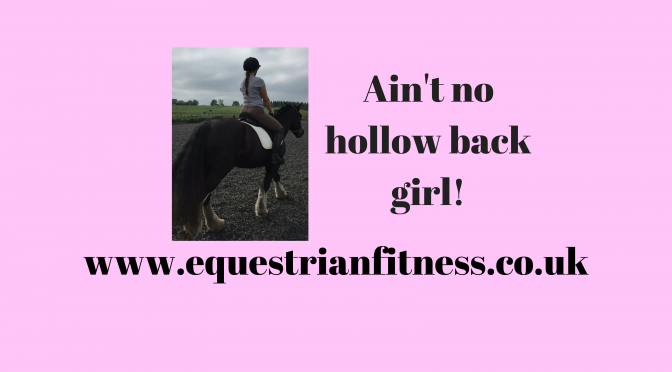
Ain’t No Hollow Back Girl


How did you get on with last weeks neutral spine?

Did you find it easy or difficult to remain in that position whilst riding?

There are many different ways that riders can deviate from a neutral position with backs arching, rounding, lateral shifts of the rub cage and curving to the side. Riders can have one or many of these things going on which will all affect your ability to stay neutral and therefore affect the aids you give to your horse.

One of the most common issues I see is a hollow back-an arched lower back causing the bum to stick out.

Now unfortunately some of us are built with a slight anterior tilt in our pelvis, which makes even regular standing and sitting in neutral spine a struggle. This doesn’t mean there is nothing you can do, it will just take some work to get the right muscles working in balance to allow a neutral pelvis. (I’ve spent around 2 years and I can now sit in a saddle in neutral I just struggle to maintain it whilst riding-but I have made huuugggee progress from where I started so it is possible!)

Add to this a Dressage saddle and we are in big trouble! You see in a GP saddle the thigh sits at approximately  a 45⁰ angle from hip to knee.  Depending on the severity of your hollow neutral spine may be achievable with adjustment in this position. In a Dressage saddle with the lengthened thigh position and usually higher cantle to really “plug” you in, the thigh is now somewhere around 35⁰ or less from hip to knee. Just to sit in a Dressage saddle automatically takes you into an anterior tilt, so in order to attain neutral you need to effectively posteriorly tilt. Which is fine if you have solid neutral already, if not then we classically see riders hollow backed, chest out and unable to use their core effectively when riding. Often these are the riders that complain of low back pain due to bracing in the back to try and absorb a big horses movement.

Aside from back pain, riding with a hollow back prevents you from being able to communicate with your seat effectively. If you can feel your seat bones at all they will most certainly not be pointing straight down rather they will be pointing backwards, and your balance will be off as your centre of gravity will ….well not be central as your chest is out, with your shoulders and bum back and your stomach lengthened. It can feel like you are working incredibly hard to give aids and they just aren’t as effective as they could be.

So, what can we do about it?

In it’s simplest form we need to release the back muscles and retrain them to work in a slightly more lengthened position and in turn retrain the abdominals to work in a slightly more shortened position. The aim being that you are actually equal length front and back.

This simple exercise with a pole is a great way to help retrain those muscles. Also look out for some more exercises on my social media across the week.


What & Why Neutral Spine?

What is Neutral Spine?

Why do we need it?

How do I get it?

Read on……

Neutral spine is when the spines natural curves flow gently into one another without postural extremes of being very rounded or arched in appearance.

If you were to draw a line from the top of the spine to the base of the spine that line would be vertical with only the slight curves away in between.

Neutral spine allows the whole skeleton to be a really effective shock absorber  with all of the movement of the horse being transferred straight through the centre of your joints. It also means you are completely in line with the pull of gravity.


If you move away from neutral you do not absorb the movement as well and the strain can be passed to the soft tissue structures surrounding the joints-tendons, ligaments etc. And this is likely over time to cause some aches and pains.

Being outside of neutral also means you are less balanced as gravity has more of a pull on you and of course this means you are more likely to fall off. Obviously gravity is always pulling on us but when it is not being opposed by good alignment and muscle tone it has more chance of pulling you down!

Imagine your body as a stack of boxes.

Pelvic box

Rib cage box

Head box

Each box can twist, tilt sideways, tilt up or down and shift sideways independently.

Your whole stacking pattern has an effect on your horse, not just your bottom and it can give your horse messages that he interprets differently to what you are intending.

Any box shifted to the left or right can be giving a weight aid -which you are then having to try and counteract with a rein aid. Any box stuck in a twist can put the horse on a particular bend and make the rein contact uneven.

Of course once in neutral alignment you may move out of it to give aids more effectively but you will then move back to neutral to make it clear to your horse that it was a single aid.

To help you maintain neutral whilst riding you can use your core stabiliser muscles-these work to keep the joint neutral not to hold it on when it’s not in neutral-that’s when the aches and pains happen.


So let’s start with the pelvic box.

Imagine the pelvis is a bowl of water. Tip the water out the front onto the pommel your back will hollow as you do this, you will feel your hip bones come forward and your pubic bone go back underneath you. Now reverse this and tip water out of the back onto the cantle you back will round your hip bones come back and your pubic bone will come forward. Now move between the two until you feel that the hip bones and pubic bone are on a vertical plane-this is neutral.

Step 2 check on the pelvic -can you feel your seat bones? Can you feel them equally? Re do the water tip if needs be to find them.


The rib cage box.

Imagine your chest is a pair of head lights-like the ones you have on your car.

Move the lights into full beam which will arch your upper back, now dip them to round your upper back and move between the points to find neutral. I also find it helpful to align my sternum with my pubic bone at this point to help.

Now close your elbows to your side. Can you feel exactly the same part of your waist,hips, rib cage on both sides or do they feel different? If you can feel yourself crooked whilst riding bringing the elbows into your sides and have them in EXACTLY the same place on each side and this should help.


Finally the head box.

I’m sure you’ve all heard this one or variants of it from riding instructors over the years and that’s because it works! Imagine your head is balloon gently floating up away from your body.

Put your fingers at the top of your neck/ base of your skull you should feel a little bony indent either side. This is the equivalent of your horses poll. Now flex your poll and then release it. When it is neutral it should feel like you can rest your fingers in the indent under the bone, when flexed the indent will flatten when extended it will close the gap.


Now recheck whether you think all the boxers are aligned.

This can be a nice exercise to run through when you first get on as you are just walking your horse around as it helps to set you up in good alignment for your ride.

Ok, so if anyone would like a little more detail on this kind of work for themselves I run a saddle horse alignment alongside a biomechanics assessment at my studio so drop me an email if you are interested in that.


A pain in the Equestrian


There is a noticeable trend with equestrians in that many of us struggle with some kind of injury or pain condition.

Of course many of these injuries and ongoing conditions are caused by numerous falls etc. over the years as its safe to say even if we are lucky enough to avoid serious injury have still taken a fair battering over the years.

I think many Equestrians could teach others some lessons in dealing with pain. As there are a huge proportion of us that no matter what we still drag ourselves up and ride half a ton of animal and nothing is going to stop us-heck some Equestrians lose limbs and it doesn’t stop them!

Why is that? Why can some people absolutely put up with whatever is thrown at them and carry on upwards when others with often less medically serious issues give up and go home?

Mind-set! You see pain is a hugely complicated issue with many factors that can influence it but one of the most important factors is your own mind.

It has become a little anecdote of mine that when I ask at initial consultations with clients if they’ve had any injuries they will reply “nothing serious……..just a broken foot, broken ribs, collarbone, vertebrae, and pins in my hip…..but nothing major!” Perhaps we just accept it as part of our sport that these things will happen?

I also think that for most of us, horses are not just a hobby we do when we have spare time, they are our life. We go to work solely to fund our horses, we go without other luxuries (apparently there are these things called beach holidays that people go on?) so our mind set is incredibly positive towards doing whatever it takes to keep horses in our lives.

I honestly believe that that is a great thing! As in most cases the exercise, fresh air and mental wellbeing that comes from being with our horses and riding is exactly what is needed to deal with pain both from a mental and a physical view-there are very few medical conditions that get better by sitting still!

Of course in my job I work with equestrians to help them become even better at dealing with and eliminating their injuries and pain issues. I’m going to talk a little bit about that in future blogs but if you would like some 121 coaching with me to help you really tackle your issues and get you back riding as your best self then hit reply!

There is also a new Wednesday evening class about to launch, 7.30pm at the studio based WN8 9QP. Only 2 spaces remaining so let me know today if you want in!

Let’s Start Playing With Those Balls…..

The last couple of weeks we have been playing around with balancing on gym balls.

This week I want to give you a couple of ides of things you can add which ever level you are at to improve your riding.

First test is once you are sitting, 4 point or kneeling on the ball and able to stay relatively still, why not see if you can carefully move from side to side and then go back to neutral -without falling off!

This is an exercise in muscular control and will help you to give very precise aids to your horse as you will be able to fully manage how much you move to give those aids.

How about trying to juggle, throw and catch a ball or have someone throw a ball to you? This is great fun in a group so why not try it with some friends at the yard. Again you can do this sitting or kneeling depending on your current skill level. This exercise works on your reaction times, as well as your ability to move your arms and remain stable. This helps with those unexpected moments and day to day your ability to give rein aids without unbalancing your seat.

Adding shoulder exercises perhaps with a band or cable machine combines shoulder stability with the already working hard hip stability. This again goes back to being able to give aids and remain balanced in your seat, but the elements of both hip and shoulder stability make this quite tricky as I have found many riders (including myself) can have great stability in the hips or shoulders when they focus on them but it is not quite so good when asked to have both at the same time!

I will be posting videos of some of these exercises across my social media.

If you check out my Facebook Page https://www.facebook.com/equestrianfitnessnicola/


Or My new Channel on Instagram TV. *You need the IGTV App then  follow me on regular Instagram @nicola_equestrianfitness and when you go to IGTV it will show you my content there.


Kneeling up on a Gym Ball-2 Point

Soooo you must be a bit of a pro on that gym ball by now?

Now for the final mastery before we start adding movement, bells and whistles!

Time to kneel up onto just your two knees-no hands for balance and just learn to sit there are hang out!

As with the other phases of gym ball work there is totally a point to this other than of course looking really really cool.

When you are in a two point position, to stay still and of course upright you need super duper hip and core stability as well as the ability to hold relaxed muscle tension-which means if you are bracing to try and stay there you will be too tense and actually more likely to fall off.

Once you have the hip stability to kneel and stay relaxed you can move on add extra elements like doing band exercises to work the shoulders at the same time, things to improve reactions and proprioception function like throwing and catching a ball.

So, as we have done every week here is a video to talk you through it. Once you know how it’s not as crazy as it seems but I will say it does require a good amount of hip stability so if you find that one hip is collapsing you need to go back and work on that first.

Also, I did my video outside in the arena (soft landing!) but you can as with the sitting exercise do this by a sturdy table, the fence etc. and use that for balance to help you out at first……………...just don’t fall off and knock yourself out on said fence!