Why do riders need to be strong?

Every time you ride each muscle in your body needs to work to control and stabilise your joints.

As I have mentioned before, riding in neutral spine, with Shoulder, Hip, Heel alignment enables all of the joints of the body to line up correctly and therefore be in the best position absorb the movement of the horse beneath you. However they can't do this without the muscles to help hold them there.

The stronger those muscles are the better they will do this and the easier they will find it.

Add to this that as many riders have spent years being bashed about and thrown off, they inevitably carry a few injuries. The most common injuries i see in my clients are back, hip and knee injuries. The best way to manage and support these injuries both on and off horse is to build strong muscles to both support the joints and heal damaged tissues.

So, if you want to ride in true self carriage, in control of your aids and hopefully pain free the answer lies in building strong muscles.

I know we think that pushing wheelbarrows and carrying feed makes us strong but in reality the majority of us don't lift correctly and also favour one side making us asymmetrical and at risk of injury. Secondly, these activities don't make us full body functional strong.

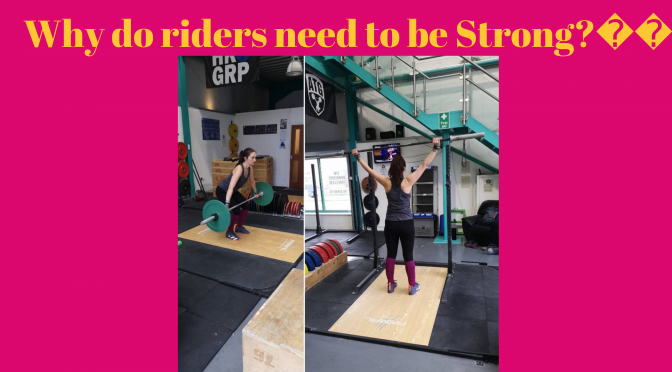
If you're new to exercise a good Pilates class is a good place to start but for the strength seen in the likes of Charlotte Dujardin some proper weight lifting is required.

It doesn't need to be overly complicated or hours of training but some basic Barbell Squats, Deadlifts combined with a  Bent Over Row and Press Ups will start to build you a solid base from top to bottom.

If you'd like some help I've set up a lifting area in a stable next to the studio-so you don't have to even go to a gym! I've got just a few slots available for 121 training so hit reply if you'd like to become a serious Equestrian Athlete this year!


Nail New Year Nutrition

So this week everyone has gone back to work, kids have gone back to school and it’s all New Year New Me……


Although actually I think there has been less of that this year which I think is a good thing. You aren’t magically going to wake up on 1st Jan only wanting green juice and coconut water. Neither should you.


Life is for living and yes food is fuel but it should also be enjoyed. But of course some of us want to lose a few pounds and that’s fine but doing that needn’t involve sacrificing all the food you enjoy and surviving on meagre rations of bird seed. 


Add to that a busy lifestyle with horses, jobs, families….. And spending hours on food prep, existing on tiny portions is not going to help you do all of that and lose weight long term.


The key to long term weight loss is actually just simple maths. You need to create a calorie deficit. Calories in needs to be less than calories out. That’s it.


Of course it makes better sense health wise to make the majority of your diet up with Vegetables, Fruit,  lean meats and pulses but there are no hard and fast rules about what you can and can’t eat to lose weight. 


I like to keep simple with my clients. We set up MyFitnessPal accounts, then start tracking every day. In the first few days we aren’t worrying too much about being over the calorie goal, we just need to know where we’re at and what sort of patterns are showing up. 


We’ve set up a little Whatsapp support group with the ladies in my class who want to lose weight-Its called “Grazing Muzzle Club” 


Once we’ve got the hang of the app and looked at our current habits it’s time to make some tweaks. Are we over our calorie allowance because of lots of snacking or because certain meals are much higher calorie than the others?Can we start to look at lower calorie meal option? Are we snacking through boredom or because of genuine hunger? If it’s boredom we need to either accept that its boredom not hunger or look for some lower calorie options to at least keep a limit on how much is consumed. Things like sugar free jelly, low calorie hot chocolate etc are great for this. If it’s genuine hunger we either need to make the meals or the snacks more filling. Usually upping the protein levels so lean meats, boiled eggs, nut butter with your apple  or a protein shake are filling options. Also ensure you are drinking enough water throughout the day.


We continue this just making tweaks as we go along until we’re comfortably in a calorie deficit without really feeling like it’s dieting, more like -This is how I eat now. 


I know this approach almost sounds too simple, and well that;s because it is simple. You still have to make the effort of logging food, starting to plan how meals will fit into your calories etc. However the freedom to make your own food choices based around what you actually like and what is convenient to your lifestyle is what throws people who are used to rules of giving up certain food groups or having weird (non scientific) points attached to things that mean they struggle to navigate an M&S lunch counter or a restaurant menu. 


So, if you’re committed to losing weight for good this year, make the commitment to keep it simple, follow the basic science of calories in vs calories out and create a diet that fits your lifestyle long term.


Here’s a couple of things I will add that will make this process easier.


  • Start to plan your meals and snacks in advance. Take into account the time you will realistically have available on those days to prepare and eat food. If you’re on the run or home late have portable and quick to prepare foods.
  • For the most part coloured vegetables -greens, purples, reds etc. have a low calorie value for the volume of food so use them to add bulk to your meals.
  • Admitting you won’t have the time or inclination to cook and therefore buying low calorie ready meals, soups, packet rice and microwave veg bags is a much better option than throwing in the towel and ordering takeaway. 
  • Weighing, measuring and searching for things in myfitnesspal can seem like  a pain at first, but you can save recipes and meals, copy them into other days etc. which makes it much easier after a couple of weeks and it starts to become more instinctive.

What are you going to achieve in 2020?

Happy New Year!

So, what has 2020 got in store for you? 

  Now is the time to sit down and plan what you want to achieve this year.

Then of course what you are going to do to achieve them. Planning is key to achieving goals. 

Are you going to take up a new discipline? Perhaps you’re taking up Dressage or Endurance.

Are you hoping to move up a level in your discipline?

Maybe it’s not entirely horse related. Perhaps you want to improve your fitness or lose weight.

Whatever it is, the key to success is firstly identifying your why.

If you know how much a goal means to you it can help to keep you going when stuff gets tough.

My why for losing weight was because I ride a pony and don’t want to be too heavy.

My why to be as physically fit as possible is because it’s helps control my hyper mobility which firstly manages the pain and secondly means I ride my pony better.

My Why for  Carriage Driving is just pure passion. I really want to do it because I love it.

So ask yourself why you want to achieve your goal and what it means to you personally, when life tries to get in the way remember this why to help push you through.

Secondly make a plan of how you are going to achieve your goal.

If you have a specific event to train for,do you need a training plan to help you peak at the right time?

Will you need extra training, a specific trainer etc? Get that organised and plan where you can fit that training in and how you will pay for it.

Do you need some new gear -any excuse right? 

Will you need to adjust your schedule to fit in your schooling sessions etc? Be realistic about what you can fit it,  but also be ready to make some sacrifices along the way. I’m sure there will have been plenty of times those at the top would have preferred to be at home watching a box set rather than riding in the cold but those box sets won’t help to improve your performance.

Those that achieve great things will have made sacrifices, had tough days and set backs along the way but because they really wanted that end result they kept going.

So, get your planner out. 

What are you going to achieve this year?

What do you need to help you achieve it? Is it new kit, support from family, friends or a coach?

How will it impact your current lifestyle and what will you need to change for it to happen?

I’d love to know what you’re goals are and how you plan to achieve them. 

Reflect on 2019

I hope you all had a lovely Christmas.

I think this time in between Christmas and new year is a great time to reflect on your achievements this year before you start planning your 2020 goals.

Hiave you done some big stuff this year with your horse this year?

Won a big class? Qualified for a big event?

Perhaps you took up a new discipline or bought a new horse?

What about other stuff? Did you get a new job or do something mad like a sky dive?

Perhaps it’s something simpler like you managed to deals with your confidence issues better this year, stuck to an exercise habit or you made more time for friends and family.

These are all achievements that have contributed to your happiness this year so it is important to acknowledge them. 

I’ve grown my business with new classes and clients this year and  I’ve done two new qualifications. 

I started the year with one pony out with a serious injury, one in rehab for  minor issues and the other with a vet saying she was dangerous and I should consider having her put to sleep. I’m ending it with both injured ponies back in work and the other not being quite so scary anymore. 

Then I’ve got back in the gym properly and taken up Olympic Lifting. Orla and I also finally took up agility this year too-she’s a natural. 

Looking at this I realise how much I’ve achieved this year and if you’ve been with me on this journey you will know how many ups and downs there were along the way, and how many times I could have quite easily have thrown in the towel and swapped it for an office job and pet hamsters! 

Amongst my clients we’ve lost horses, gained horses, had lame horses, prize winning horses and lots of firsts of everything from getting on board to eventing. It’s been so important to have each other to remind us of how far we’ve come when at that moment it feels like we’ve gone nowhere at all.

So, before you start planning 2020 look at what you achieved in 2019. Be proud of yourself for those achievements, and then look at what you didn’t achieve and ask yourself why? Did circumstances just throw you off course (injuries and illness etc) or did you just not want it hard enough? 

This will make planning 2020 a little clearer.

I’d love to know what you’ve achieved with your horse this year.

Shock Absorbing Ankles

Whilst I’m not a huge advocator for putting too much weight in the stirrup (if you press down you’ll pop your seat up….. its physics) we do still need a connection to the stirrup and the ability to absorb the movement of the horse through our lower leg and ankle. Being unable to do this causes our lower leg to flop around and essentially be ineffective.


There are two elements to being a good shock absorber. 


The first one is the mobility of the joint to move freely. If a joint is stiff and restricted the movement of the horse becomes an impact -think hitting a wall rather than an absorption of force such as hitting a boxing pad.


To mobilise the joint is very simple, just making circles in both directions aiming to take the joint through its full range of motion each way.


Secondly we need to ensure the joint is not restricted by the muscles attached to it. This means stretching the calf muscles.


I like this kneeling stretch as it hits both the big calf muscle (the Gastrocnemius) and the often forgotten smaller muscle below it (the soleus). 

Now they are mobile we need to strengthen them.

The muscles around the foot, ankle and shin can be strengthened using a resistance band to pull away from the outside of the foot and then the inside.

Then having a strong set of calves can help so simple, slow, controlled raises off a step can do this.

Then to up the ante, some instability work on a balance pod (with no shoes on). Just trying to stand on one leg on these can be a challenge, but once you’ve mastered that you can add Single Leg Deadlift and Squats….

Release Your Shoulders For Better Rein Contact

As a horse owner your shoulders take a bit of a battering. Firstly there’s all the mucking out, lifting feed etc. Then there’s the extra “fun” of your horse dragging you off for some grass, maybe having a mad gallop on the lunge……


Alongside this you may also have a desk job, do a lot of driving and therefore spend a lot of time hunched over.


Add to this the stressful nature of life and horse owning sometimes and you might find your shoulders are solid bricks stuck to your ear lobes most of the time.


However when we ride those shoulders are in charge of the hands attached to the reins. Your shoulder is the joint at which your arm is attached and therefore it’s function is vital to the function of your arms. If they are stiff or weak they aren’t going to be that soft, steady contact we want to give out horse.


Here are a couple of simple exercises to help you first release your shoulders and then activate them to keep them strong and ready to ride.


Yoga for Equestrians

Last week we looked at the benefits of Pilates for riders, so this week let’s look at Yoga for riders. I use both in my classes as I think they are equally beneficial, however they do differ slightly. 


Yoga tends to focus on the lengthening of muscles and often there is a relaxation element. However I teach specifically Sports Yoga which adds in the stability element found in Pilates. Yoga is also a really good way of teaching Proprioception and body awareness due to some of the postures requiring movement and balance, as well as being able to join movements together to create a flow that will challenge coordination and concentration alongside stability and strength.


Sports Yoga specifically looks at the demands of a sport, the areas that may become shortened/tight and then the areas that need strengthening to improve performance. 


For riders this would be a focus on 


  • Symmetry 
  • Both mobility & stability in the hips
  • Stability in the core
  • Stability of the shoulders
  • Mobility and shock absorption of the ankles -I’m going to look at this next week 
  • Body awareness 


Adding yoga to your routine needn’t take up hours of your time, just 10 minutes a couple of times per week is enough for you to feel the benefit.


Here is a short flow you can use to improve your body’s performance for riding.

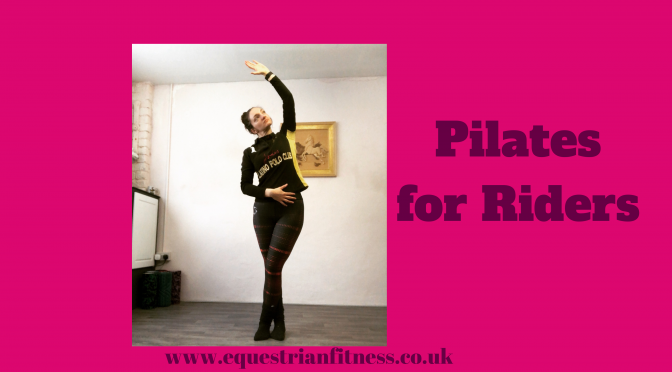
Pilates for Riders

I don’t think it’s a new concept that Pilates is good for riders, but exactly why is it such a good off horse training method.

Pilates cites it fundamental principles as.

  • Breath
  • Concentration
  • Centring
  • Control
  • Precision
  • Flow


So, if we were masters of these qualities in our own bodies do you reckon that would make you a better rider? Damn right it would!

As an Equipilates ™️ instructor I often incorporate breathing exercises into my classes, in particular exercises that can then be used on horse to address issues such as tension, straightness or the obvious not breathing during a lesson! 

Concentration is a vital part of riding. It can be so difficult to completely focus on what you are doing  when often there can be lots of distractions in the form of other horses and people, maybe general activity in and around the yard and topped off with whatever else is going on in your life and therefore your head right now. Concentration can be practiced as a skill which over time will transfer to your riding and other areas of your life.

Centering is connecting with your core. I’m sure you’re aware that a good core is a huge benefit for riding, and being able to really connect and control it whilst on a horse will improve your balance and aids no end. Your arms and legs need a solid base from which to move, this alongside the ability to absorb the horses movement underneath you is the job of a stable core.

Control-Being able to have awareness and control of the muscles being activated enables you give precise, clear aids. It enables you to correct yourself where necessary and assist in correcting your horse and remain n balance.

Precision-As just mentioned, controlled precise aids are clear aids. Your horse may well be listening to you but you aren’t getting the answer that you want because your question isn’t right. Precision is key.

Flow. This really ties to principles together. The ability to move fluidly with control and precision is when riding looks to outsiders to be effortless. Harmony in your own body will help to create harmony with your horse.


Here are a couple of my favourite Equipilates™️ exercises to help with these key principles.


Drop drop Dead Bug


Teaser

Bridge March


Fit to Ride?

It’s difficult to assess fitness for riding because it contains so many components-one being a wild animal. Others being experience, technical ability and then the question as to whether you are fit for intro Dressage or Badminton as they would be different levels of fitness.


However Jockeys have to pass a fitness test to gain their licence so I thought I would have a look at what that entails-ignoring the fact I eat too much food to ever make weight as a female jockey!


There are various different tests for muscular endurance, core power and cardio fitness-The Bleep Test, for which I still have psychological issues with from school and I’m not ready to tackle those demons yet.


However muscular endurance I reckon I could give a crack.


So just for fun (ok I have different ideas of fun) I picked out these two tests from the Jockey fitness Test. 


You get a score out of 100 based on the time you achieve.


Stupidly I did my first attempt at these after a heavy training session so I was nowhere near fresh! However I managed a 2 minute plank which would be 50% so not great p. The leg repetition and hold I managed the full 2 minutes though so I was pretty pleased with that; I’m not going to lie it burned like hell!


Plank -on Forearms and toes for up to 4 minutes. 

60-25%

120-50%

180-75%

240-100%


Exercise Ball leg repetitions and hold.

Squat with gym ball behind you for 20 reps, then hold a 5kg weight and hold with thighs at 90 degrees for up 2 minutes.


30-25%

60-50%

90-75%

120-100%


Why don’t you challenge your yard friends and see how you score!


Do you switch on before you ride?

When you first get on your horse you warm him up don’t you? You ask him to start gently moving, warm up and wake up his muscles to prepare him for the work you are about to ask him to do.


What about you? Do you wake up your muscles before you ride? Ok you may have done some yard work so you are not physically cold but have you activated and prepared the specific muscles you are about to use to ride your horse? Thought not.


In terms of specific warm up these are individual to the riders needs. 


However there are some common muscles we all use when riding that will benefit from being activated before you get on. It should only take a couple of minutes and can all be done at that yard in your riding gear. 


I’ve collectively referred to the muscles as the areas they refer to so it makes it relevant to what you are doing it for.


Seat muscles-Stand side on to a wall, lift the leg closest to the wall up, knee bent at 90 degrees. Press the leg right from the outer hip to knee into the wall for 30 seconds, release and then repeat 3-4 times. Then change leg. If you have a block or foam roller handy you can put this against the wall to press against as this makes it slightly easier to get a good press.

Rein Contact.

Stand in a door way, point your elbows into your sides and press your forearms against the doorway-keep your elbows pointing in. Push for 30 secs repeat 3-4 times.